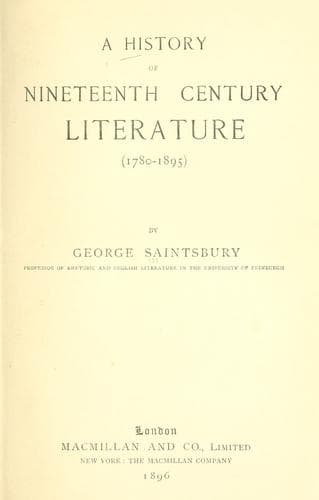
A History of Nineteenth Century Literature (1780-1895)Saintsbury, George
History
A History of Nineteenth Century Literature (1780-1895)
Saintsbury, George
English literature -- 19th century -- History and criticism
One indeed of the most wonderful things about her is her earliness. Even
the dates of publication of her first books precede those of any
novelist of the same rank and the same modernity; but these dates are
misleading. _Northanger Abbey_ was written more than twenty years before
it appeared, and the bulk of _Pride and Prejudice_ (which some hold to
be the best and most characteristic of all) is known to have been as old
at least as _Northanger Abbey_. That is to say, almost at the very time
of the appearance of _Camilla_ (to which, by the way, Miss Austen was an
original subscriber), a book not strikingly more nineteenth century in
tone than the novels of Richardson, though a little more so in manners,
a girl even younger than Miss Burney herself had been when she wrote
_Evelina_ was drawing other girls, who, putting aside the most trivial
details of dress, speech, and so forth, might be living girls to-day.
The charm and the genius of Miss Austen are not universally admitted;
the touch of old fashion in external detail apparently discontenting
some readers, the delicate and ever-present irony either escaping or
being distasteful to others, while the extreme quietness of the action
and the entire absence of excitement probably revolt a third class. But
the decriers do not usually attempt formal criticism. However, they
sometimes do, and such an attempt once came under the notice of the
present historian. It was urged that to extol Miss Austen's method is a
masculine delusion, that method being nothing but the throwing into
literature of the habit of minute and semi-satiric observation natural
to womankind. It did not apparently occur to this critic that he (or
she) was in the first place paying Miss Austen an extraordinarily high
compliment--a compliment almost greater than the most enthusiastic
"Janites" have ventured--inasmuch as no higher literary triumph can be
even conceived than thus to focus, formulate, and crystallise the
special talent and gift of an entire sex into a literary method. Nor did
it probably occur to him that he was laying himself open to the
damaging, or rather ruinous retort, "Then how is it that, of all the
women who have preceded and followed Miss Austen as novelists, no other
has displayed this specially and universally feminine gift?"
Public-domain text, read in full here on John Shaqi.
Reviews
Reviews
No reviews yet
Be the first to share your thoughts on this work.
Elsewhere in the archive
Join the Discussion
Join the discussion
Sign in to leave a comment or review.
Sign InorCreate an account