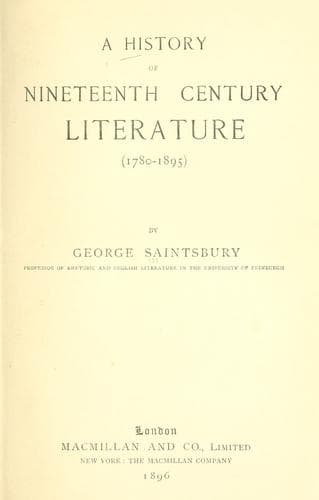
A History of Nineteenth Century Literature (1780-1895)Saintsbury, George
History
A History of Nineteenth Century Literature (1780-1895)
Saintsbury, George
English literature -- 19th century -- History and criticism
It is not possible--it never is in such cases--to give a very exact
account of the causes which led Walter Scott, when the public seemed to
be a little tiring of the verse-romances which have been discussed in
the last chapter, to take to romances in prose. The example of Miss
Edgeworth, if a true cause at all, could affect only his selection of
Scotch manners to illustrate his histories, not his adoption of the
historical style itself. But he did adopt it; and, fishing out from an
old desk the beginnings of a story which he had left unfinished, or
rather had scarce commenced, years earlier, he fashioned it into
_Waverley_. This appearing in the year 1814 at a serious crisis in his
own affairs, opened at once a new career of fame and fortune to him,
and a previously unknown field of exploit and popularity to the English
novel.
The extraordinary greatness of Scott--who in everything but pure style,
and the expression of the highest raptures of love, thought, and nature,
ranks with the greatest writers of the world--is not better indicated by
any single fact than by the fact that it is impossible to describe his
novels in any simple formula. He practically created the historical
novel; and, what is more, he elaborated it to such an extent that no
really important additions to his scheme have been made since. But not
all his novels are historical. The two which immediately succeeded
_Waverley_, and which perhaps the best judges consider his best,--_Guy
Mannering_ and _The Antiquary_,--have only the faintest touch of history
about them, and might have none at all without affecting their
excellence; while one of the most powerful of his later books, _St.
Ronan's Well_, is almost absolutely virgin of fact. So also, though his
incomparable delineation of national manners, speech, and character, of
the _cosas de Escocia_ generally, is one of the principal sources of his
interest, _Ivanhoe_, which has perhaps been the most popular of all his
books, _Kenilworth_, which is not far below it in popularity or in
merit, and one or two others, have nothing at all of Scotland in them;
and the altogether admirable romance of _Quentin Durward_, one of his
four or five masterpieces, so little that what there is plays the
smallest part in the success. So yet again, historical novelist as Scott
is, and admirably as he has utilised and revivified history, he is by no
means an extremely accurate historical scholar, and is wont not merely
to play tricks with history to suit his story,--that is probably always
allowable,--but to commit anachronisms which are quite unnecessary and
even a little teasing.
Public-domain text, read in full here on John Shaqi.
Reviews
Reviews
No reviews yet
Be the first to share your thoughts on this work.
Elsewhere in the archive
Join the Discussion
Join the discussion
Sign in to leave a comment or review.
Sign InorCreate an account