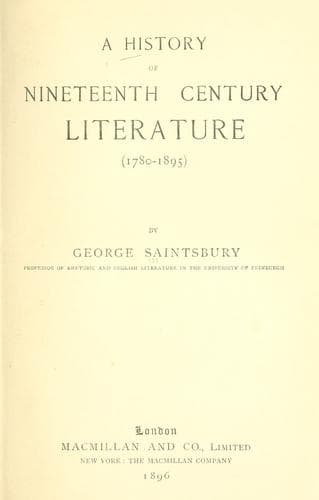
A History of Nineteenth Century Literature (1780-1895)Saintsbury, George
History
A History of Nineteenth Century Literature (1780-1895)
Saintsbury, George
English literature -- 19th century -- History and criticism
For the moment, however, Miss Austen's example had not so much little
influence as none at all. A more powerful and popular force, coming
immediately afterwards and coinciding with the bent of general taste,
threw for the time the whole current of English novel writing into quite
a different channel; and it was not till the first rush of this current
had expended itself, after an interval of thirty or forty years, that
the novel, as distinguished from the romance and from nondescript styles
partaking now of the romance itself, now of something like the
eighteenth century story, engaged the popular ear. This new development
was the historical novel proper; and the hand that started it at last
was that of Scott. At last--for both men and women had been trying to
write historical novels for about two thousand years, and for some
twenty or thirty the attempts had come tolerably thick and fast. But
before Scott no one, ancient or modern, Englishman or foreigner, had
really succeeded. In the first place, until the eighteenth century was
pretty far advanced, the conception and the knowledge of history as
distinguished from the mere writing and reading of chronicles had been
in a very rudimentary condition. Exceedingly few historians and no
readers of history, as a class and as a rule, had practised or acquired
the art of looking at bygone ages with any attempt to realise and revive
the ideas of those ages themselves, or even, while looking at them with
the eyes of the present, to keep in mind that these were quite different
eyes from those of contemporaries. In the same way no attempt at getting
"local colour," at appropriateness of dialect, and so forth, had been
made. These negligences in the hands of genius had been as unimportant
as the negligences of genius always are. If Shakespeare's "godlike
Romans" are not entirely free from anachronism, nobody of sense would
exchange them for anything else than themselves; and though Dante
practically repeated in the _Commedia_ the curious confusion which in
less gifted _trouveres_ and romances mixed up Alexander with Charlemagne
and blended Greek and Gothic notions in one inextricable tangle, this
also was supremely unimportant, if not even in a manner interesting. But
when, at the end of the eighteenth century, writers, of secondary powers
at best, engaging in a new and unengineered way, endeavoured to write
historical novels, they all, from Godwin and Mrs. Radcliffe to Miss
Reeves and the Misses Lee, made the merest gallimaufries of inaccurate
history, questionable fiction, manners heedlessly jumbled, and above all
dialogue destitute of the slightest semblance of verisimilitude, and
drawn chiefly from that of the decadent tragic and comic drama of the
time.
Public-domain text, read in full here on John Shaqi.
Reviews
Reviews
No reviews yet
Be the first to share your thoughts on this work.
Elsewhere in the archive
Join the Discussion
Join the discussion
Sign in to leave a comment or review.
Sign InorCreate an account