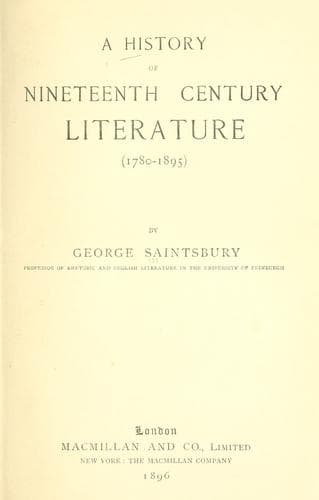
A History of Nineteenth Century Literature (1780-1895)Saintsbury, George
History
A History of Nineteenth Century Literature (1780-1895)
Saintsbury, George
English literature -- 19th century -- History and criticism
majority of the contributors were Whigs, and the whole cast of the
periodical became more and more of that complexion, till at last,
private matters helping public, a formidable secession took place, and
the _Quarterly_ was founded.
From time to time students of literature turn to the early numbers of
these famous periodicals, of the _Edinburgh_ especially, with the
result, usually of a certain, sometimes of a considerable,
disappointment. With the exception of a few things already known from
their inclusion in their authors' collected works, the material as a
whole is apt to seem anything but extraordinarily good; and some wonder
is often expressed at the effect which it originally had. This arises
from insufficient attention to a few obvious, but for that very reason
easily neglected, truths. The inquirers as a rule have in their minds
much more what has followed than what has gone before; and they contrast
the early numbers of the _Edinburgh_, not with its jejune forerunners,
but with such matured instances as Macaulay's later essays; the early
numbers of the _Quarterly_, not with the early numbers of the
_Edinburgh_, but with their own successors. Again it is apt to be
forgotten that the characteristics of joint-stock periodical-writing
make as much for general inequality as for occasional goodness. That
which is written by many hands will seldom be as bad, but can never be
as good, as that which is written by one; that which takes its texts and
starting-points from suggested matters of the moment will generally
escape the occasional dulness, but can rarely attain the occasional
excellence, of the meditated and original sprout of an individual brain.
The _Edinburgh_ in its early years was undoubtedly surpassed by itself
later and by its rivals; but it was a far greater advance upon anything
that had gone before it. It had the refreshing audacity, the fly-at-all
character of youth and of intellectual opposition to established ideas;
it was, if even from the first not free from partisanship, at any rate
not chargeable with the dull venal unfairness of the mere bookseller's
hack who attacks Mr. Bungay's books because he is employed by Mr. Bacon,
or _vice versa_. And it had a very remarkable staff, comprising the
learning and trained intelligence of men like Leslie and Playfair, the
unrivalled wit of Sydney Smith, the restless energy and occasional
genius of Brougham, the solid profundity of Horner, the wide reading and
always generous temper of Scott, and other good qualities of others,
besides the talents of its editor Jeffrey himself.
Public-domain text, read in full here on John Shaqi.
Reviews
Reviews
No reviews yet
Be the first to share your thoughts on this work.
Elsewhere in the archive
Join the Discussion
Join the discussion
Sign in to leave a comment or review.
Sign InorCreate an account