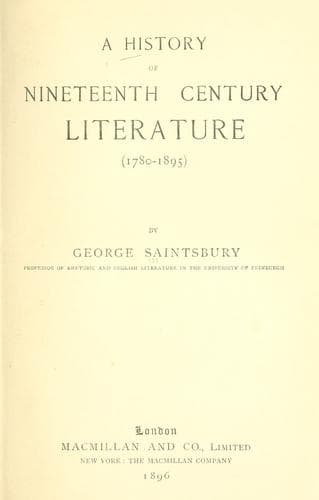
A History of Nineteenth Century Literature (1780-1895)Saintsbury, George
History
A History of Nineteenth Century Literature (1780-1895)
Saintsbury, George
English literature -- 19th century -- History and criticism
Of these talents there is no doubt, though they were initially somewhat
limited and not seldom misdirected afterwards. Jeffrey's entire energies
were absorbed by the _Review_ between its foundation and his resignation
of the editorship after nearly thirty years' tenure, soon after which,
his party at last coming into power, he was rewarded first by the Lord
Advocateship and then by a seat on the Bench. He made a very fair judge,
and held the post almost till his death in 1850. But his life, for the
purposes of literature, is practically comprised between 1802 and 1829,
during which he was far more than titularly the guiding spirit of the
_Review_. Recently, or at any rate until quite recently (for there has
been some reaction in the very latest days), the conception of an editor
has been of one who writes not very much, and, though choosing his
contributors with the best care he can give, does not interfere very
much with them when they are chosen. This was very far from being the
Jeffreyan ideal. He wrote a great deal,--often in the earlier years as
many as half a dozen articles in a number,--and he "doctored" his
contributors' articles (except in the case of persons like Sydney Smith,
who were of too unconquerable idiosyncrasy and too valuable) with the
utmost freedom. At the present day, however, his management of the
_Review_ is less interesting than his own work, which he himself in his
later years collected and selected in an ample definitive edition. It is
exceedingly interesting, and for a good many years past it has been
distinctly undervalued; the common, though very uncritical, mistake
having been made of asking, not whether Jeffrey made a good fight for
his own conclusions from his own premises, but whether he approved or
disapproved authors whom we now consider great. From this latter point
of view he has no doubt small chance. He began by snubbing Byron, and
did not change his tone till politics and circumstances combined made
the change obligatory; he pooh-poohed and belittled his own contributor
and personal friend Scott; he pursued Wordsworth with equal
relentlessness and ill-success. And these three great examples might be
reinforced with whole regiments of smaller ones. A more serious fault
perhaps was the tone which he, more than any one else, impressed on the
_Review_, and which its very motto expressed, as though an author
necessarily came before the critic with a rope about his neck, and was
only entitled to be exempted from being strung up _speciali gratia_.
This notion, as presumptuous as it is foolish, is not extinct yet, and
has done a great deal of harm to criticism, both by prejudicing those
who are not critical against critics, and by perverting and twisting the
critic's own notion of his province and duty.
Public-domain text, read in full here on John Shaqi.
Reviews
Reviews
No reviews yet
Be the first to share your thoughts on this work.
Elsewhere in the archive
Join the Discussion
Join the discussion
Sign in to leave a comment or review.
Sign InorCreate an account