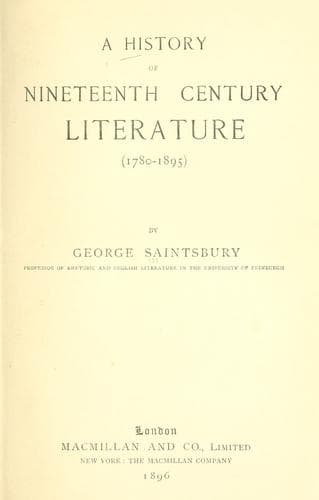
A History of Nineteenth Century Literature (1780-1895)Saintsbury, George
History
A History of Nineteenth Century Literature (1780-1895)
Saintsbury, George
English literature -- 19th century -- History and criticism
While Roscoe and Mitford were thus dealing with foreign and ancient
subjects, English history became the theme of a somewhat younger pair of
historians, one of whom, Sharon Turner, was born in 1768 and died in
1847; while John Lingard, born three years later, outlived Turner by
four. Lingard was a Roman Catholic priest, and after being educated at
Douai, divided most of his time between pastoral work and teaching at
the newly founded Roman Catholic school of Ushaw. He was the author of
what still retains the credit of being the best history of England on
the great scale, in point of the union of accuracy, skilful arrangement,
fairness (despite his inevitable prepossessions), and competent literary
form,--no mean credit for a member of an unpopular minority to have
attained in a century of the most active historical investigation.
Turner was more of a specialist and particularist, and his style is not
very estimable. He wrote many books on English history, those on the
later periods being of little value. But his _History of the
Anglo-Saxons_, first issued in 1799, was based on thorough research, and
may be said to have for the first time rescued the period of origins of
English history from the discreditable condition of perfunctory,
traditional, and second- or third-hand treatment in which most, if not
all, previous historians of England had been content to leave it.
Sir Francis Palgrave, another historian to whom the student of early
English history is deeply indebted, was born in London in 1788, his
paternal name being Cohen. He took to the law, and early devoted himself
both within and outside his profession to genealogical and antiquarian
research. Before much attention had been paid in France itself to Old
French, he published a collection of Anglo-Norman poems in 1818, and
from these studies he passed to that of English history as such. He was
knighted in 1832, and made Deputy-Keeper of the Records in 1838; his
tenure of this post being only terminated by his death in 1861. Palgrave
edited many State documents (writs, calendars, rolls, and so forth), and
in his last years executed a _History of Normandy and England_ of great
value. His considerable literary power became more considerable still in
two of his sons: the eldest, for some time past Professor of Poetry at
Oxford, Mr. F. T. Palgrave, being still alive, and therefore merely to
be mentioned; while the second, William Gifford, who was born in 1826
and died in 1888, Minister at Monte Video, was a man of the most
brilliant talents and the most varied career. He was a soldier, a
Jesuit, a traveller in the most forbidden parts of Arabia at the expense
of a foreign country, and for nearly a quarter of a century a member of
the consular and diplomatic service of his own. His _Narrative_ of his
Arabian journey, his _Dutch Guiana_, and some remarkable poems are only
a few of his works, all of which have strong character.
Public-domain text, read in full here on John Shaqi.
Reviews
Reviews
No reviews yet
Be the first to share your thoughts on this work.
Elsewhere in the archive
Join the Discussion
Join the discussion
Sign in to leave a comment or review.
Sign InorCreate an account