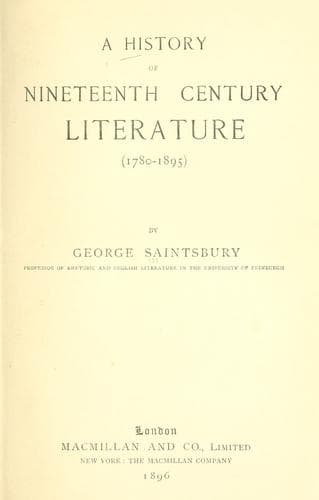
A History of Nineteenth Century Literature (1780-1895)Saintsbury, George
History
A History of Nineteenth Century Literature (1780-1895)
Saintsbury, George
English literature -- 19th century -- History and criticism
Nearly contemporary with these was Dr. Thomas M'Crie (1772-1835), whose
_Lives of Knox_ (1812) and _Melville_ (1819) entitle him to something
like the title of Historian of Scotch Presbyterianism in its militant
period. M'Crie, who was styled by Hallam (a person not given to
nicknames), "the Protestant Hildebrand," was a worthy and learned man of
untiring industry, and his subjects so intimately concern not merely
Scottish but British history for nearly two centuries, that his handling
of them could not but be important. But he was desperately prejudiced,
and his furious attack on Sir Walter Scott's _Old Mortality_, by which
he is perhaps known to more persons than by his own far from
uninteresting works, argues a crass deficiency in intellectual and
aesthetic comprehension.
The tenth decade of the eighteenth century was as much a decade of
historians as the eighth had been a decade of poets; and with Milman and
Tytler born in 1791, Alison in 1792, Grote in 1794, Arnold and Carlyle
in 1795, Thirlwall in 1797, and Macaulay in 1800, it may probably
challenge comparison with any period of equal length. The batch falls
into three pretty distinct classes, and the individual members of it are
also pretty widely separated in importance, so that it may be more
convenient to discuss them in the inverse order of their merit rather
than in the direct order of their births.
Patrick Fraser Tytler, son and grandson of historians (his grandfather
William being the first and not the worst champion of Queen Mary against
the somewhat Philistine estimates of Hume and Robertson, and his father
Alexander a Professor of History, a Scotch Judge, and an excellent
writer in various kinds of _belles lettres_), was a man of the finest
character, the friend of most of the great men of letters at Edinburgh
in the age of Scott and Jeffrey, and the author of an excellent _History
of Scotland_ from Alexander the Third to the Union of the Crowns. He was
born in 1791, was called to the Scotch Bar in 1813, and died young for a
historian (a class which has so much to do with Time that he is apt to
be merciful to it) in 1849. He was perhaps hardly a man of genius, but
he commanded universal respect. Sir Archibald Alison was the son of a
clergyman of the same name, who, after taking orders in England and
holding some benefices there, became known as the author of _Essays on
the Principles of Taste_, which possess a good deal of formal and some
real merit. Archibald the younger was highly distinguished at the
University of Edinburgh, was called to the Scotch Bar, and distinguished
himself there also, being ultimately appointed Sheriff of Lanarkshire.
Like most of the brighter wits among his immediate contemporaries in
Scotland (we have the indisputable testimony of Jeffrey to the fact)
Alison was an out-and-out Tory, and a constant contributor to
_Blackwood_, while his literary activity took very numerous shapes. At
last he began, and in the twenty years from 1839 to 1859 carried
Public-domain text, read in full here on John Shaqi.
Reviews
Reviews
No reviews yet
Be the first to share your thoughts on this work.
Elsewhere in the archive
Join the Discussion
Join the discussion
Sign in to leave a comment or review.
Sign InorCreate an account