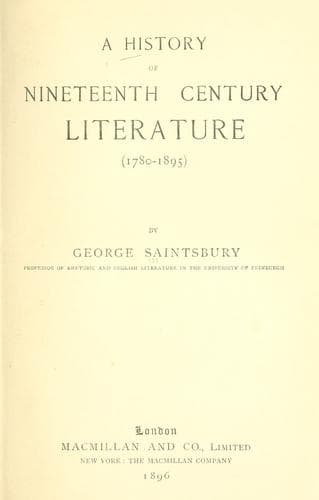
A History of Nineteenth Century Literature (1780-1895)Saintsbury, George
History
A History of Nineteenth Century Literature (1780-1895)
Saintsbury, George
English literature -- 19th century -- History and criticism
Thirlwall wrote many Charges, some of them famous, some delightful
letters, part of a translation of Niebuhr, and some essays, while Grote,
besides his historical work, produced some political and other work
before it, with a large but not very good book on Plato, and the
beginning of another on Aristotle after it. But it is by their
_Histories of Greece_ that they must live in literature. These histories
(of which Grote's was planned and begun as early as 1823, though not
completed till long afterwards, while Thirlwall's began to appear in
1835, and was finished just after Grote's saw the light) were both
written with a certain general similarity of point of view as antidotes
to Mitford, and as putting the Liberal view of the ever memorable and
ever typical history of the Greek states. But in other respects they
diverge widely; and it has been a constant source of regret to scholars
that the more popular, and as the French would say _tapageur_, of the
two, to a considerable extent eclipsed the solid worth and the excellent
form of Thirlwall. Grote's history displays immense painstaking and no
inconsiderable scholarship, though it is very nearly as much a "party
pamphlet" as Macaulay's own, the advocate's client being in this case
not merely the Athenian democracy but even the Athenian demagogue. Yet
it to a great extent redeems this by the vivid way in which it makes the
subject alive, and turns Herodotus and Thucydides, Demosthenes and
Xenophon, from dead texts and school-books into theses of eager and
stimulating interest. But it has absolutely no style; its scale is much
too great; the endless discussions and arguments on quite minor points
tend to throw the whole out of focus, and to disaccustom the student's
eye and mind to impartial and judicial handling; and the reader
constantly sighs for the placid Olympian grasp of Gibbon, nay, even for
the confident dogmatism of Macaulay himself, instead of the perpetual
singlestick of argument which clatters and flourishes away to the utter
discomposure of the dignity of the Historic Muse.
Public-domain text, read in full here on John Shaqi.
Reviews
Reviews
No reviews yet
Be the first to share your thoughts on this work.
Elsewhere in the archive
Join the Discussion
Join the discussion
Sign in to leave a comment or review.
Sign InorCreate an account