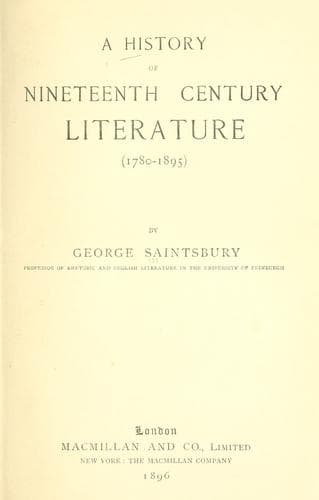
A History of Nineteenth Century Literature (1780-1895)Saintsbury, George
History
A History of Nineteenth Century Literature (1780-1895)
Saintsbury, George
English literature -- 19th century -- History and criticism
It is possible, on the other hand, that Thirlwall may have sacrificed a
little too much, considering his age and its demands, to mere
dispassionate dignity. He is seldom picturesque, and indeed he never
tries to be so. But to a scholarship naturally far superior to Grote's,
he united a much fairer and more judicial mind, and the faculty of
writing--instead of loose stuff not exactly ungrammatical nor always
uncomely, but entirely devoid of any grace of style--an excellent kind
of classical English, but slightly changed from the best eighteenth
century models. And he had what Grote lacked, the gift of seeing that
the historian need not--nay, that he ought not to--parade every detail
of the arguments by which he has reached his conclusions; but should
state those conclusions themselves, reserving himself for occasional
emergencies in which process as well as result may be properly
exhibited. It is fair to say, in putting this curious pair forward as
examples respectively of the popular and scholarly methods of historical
writing, that Grote's learning and industry were very much more than
popular, while Thirlwall's sense and style might with advantage have put
on, now and then, a little more pomp and circumstance. But still the
contrast holds; and until fresh discoveries like that of the _Athenian
Polity_ accumulate to an extent which calls for and obtains a new real
historian of Greece, it is Thirlwall and not Grote who deserves the
first rank as such in English.
Intimately connected with all these historians in time and style, but
having over them the temporary advantage of being famous in another way,
and the, as some think, permanent disadvantage of falling prematurely
out of public favour, was Thomas Arnold. He was born at Cowes, in the
Isle of Wight, on 13th June 1795, and was educated at Winchester and at
Corpus Christi College, Oxford. At the age of twenty he was elected a
fellow of Oriel--a distinction which was, and remained for two decades,
almost the highest in the University--and he gained both Chancellor's
Essay prizes, for Latin and English. Oriel was not in his time, as it
was very shortly afterwards, a centre of ecclesiastical orthodoxy; but
rather the home of a curious transition blend of thought which in
different persons took the high-and-dry or the Rationalist direction,
and was only generally opposed to Evangelicalism. Arnold himself
inclined to the Liberal side, and had also strong personal gifts for
teaching. He took orders, but neither became a tutor nor took a living,
and established himself at Laleham, on the Thames, to take private
pupils. After ten years' practice here he was elected to the
Head-mastership of Rugby, a school then, after vicissitudes, holding
little if anything more than a medium place among those English Grammar
Schools which ranked below the great schools of Eton, Harrow,
Westminster, Winchester, and Charterhouse. How he succeeded in placing
Public-domain text, read in full here on John Shaqi.
Reviews
Reviews
No reviews yet
Be the first to share your thoughts on this work.
Elsewhere in the archive
Join the Discussion
Join the discussion
Sign in to leave a comment or review.
Sign InorCreate an account