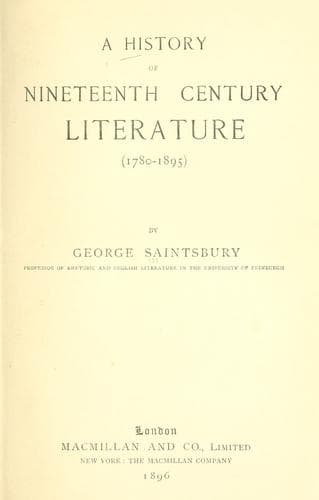
A History of Nineteenth Century Literature (1780-1895)Saintsbury, George
History
A History of Nineteenth Century Literature (1780-1895)
Saintsbury, George
English literature -- 19th century -- History and criticism
In the second division, that of essay writing, Macaulay occupies a
position both absolutely and relatively higher. That the best verse
ranks above even the best prose is not easily disputable; that prose
which is among the very best of its own particular kind ranks above
verse which though good is not the best, may be asserted without any
fear. And in their own kind of essay, Macaulay's are quite supreme.
Jeffrey, a master of writing and a still greater master of editing, with
more than twenty years' practice in criticism, asked him "where he got
that style?" The question was not entirely unanswerable. Macaulay had
taken not a little from Gibbon; he had taken something from a then still
living contributor of Jeffrey's own, Hazlitt. But his private and
personal note was after all uppermost in the compound. It had appeared
early (it can be seen in things of his written when he was an
undergraduate). It owed much to the general atmosphere of the century,
to the habit of drawing phrase, illustration, idea, not merely from the
vernacular or from classical authorities, but from the great writers of
earlier European literature. And it would probably have been impossible
without the considerable body of forerunners which the _Edinburgh_, the
_Quarterly_, and other things of which some notice has been given in a
former chapter, had supplied. But still the individual character reigns
supreme.
Macaulay's Essays are in something more than the ordinary loose
acceptation of the term a household word; and it cannot be necessary to
single out individual instances where almost all are famous, and where
all deserve their fame. The "Milton" and the "Southey," the "Pitt" and
the "Chatham," the "Addison" and the "Horace Walpole," the "Clive" and
the "Hastings," the "Frederick the Great" and the "Madame D'Arblay," the
"Restoration Dramatists" and the "Boswell," the "Hallam" and the
"Ranke," present with a marvellous consistency the same merits and the
same defects. The defects are serious enough. In the first place the
system, which Macaulay did not invent, but which he carried to
perfection, of regarding the particular book in hand less as a subject
of elaborate and minute criticism and exposition than as a mere
starting-point from which to pursue the critic's own views of the
subject, inevitably leads to unfairness, especially in matters of pure
literature. Macaulay's most famous performance in this latter kind, the
crushing review of the unlucky Robert Montgomery, though well enough
deserved in the particular case, escapes this condemnation only to fall
under another, that of looking at the parts rather than at the whole. It
is quite certain that, given their plan, the two famous critiques of
Tennyson and Keats, in the _Quarterly_ and in _Blackwood_, are well
enough justified. The critic looks only at the weak parts, and he judges
the weak parts only by the stop-watch. But, on his own wide and more
Public-domain text, read in full here on John Shaqi.
Reviews
Reviews
No reviews yet
Be the first to share your thoughts on this work.
Elsewhere in the archive
Join the Discussion
Join the discussion
Sign in to leave a comment or review.
Sign InorCreate an account