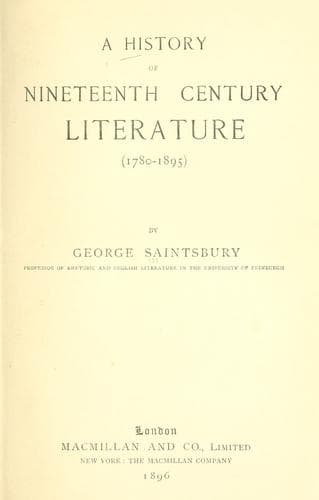
A History of Nineteenth Century Literature (1780-1895)Saintsbury, George
History
A History of Nineteenth Century Literature (1780-1895)
Saintsbury, George
English literature -- 19th century -- History and criticism
The literary personality of Macaulay, though a great one in all
respects, is neither complex nor unequally present, and it is therefore
desirable to discuss all its manifestations together. In the order of
importance and of bulk his work may be divided into verse, prose-essays,
and history, for his speeches less directly concern us, and are very
little more than essays adroitly enough adjusted so as not to be tedious
to the hearer. In all three capacities he was eminently popular; and in
all three his popularity has brought with it a sort of reaction, partly
justified, partly unjust. The worst brunt of this reaction has fallen
upon his verse, the capital division of which, the _Lays of Ancient
Rome_, was persistently decried by Mr. Matthew Arnold, the critic of
most authority in the generation immediately succeeding Macaulay's. A
poet of the very highest class Macaulay was not; his way of thought was
too positive, too clear, too destitute either of mystery or of dream, to
command or to impart the true poetical mirage, to "make the common as if
it were not common." His best efforts of this kind are in small and not
very generally known things, the "Jacobite's Epitaph," "The Last
Buccaneer." But his ballads earlier and later, _Ivry_, _The Armada_,
_Naseby_, and the Roman quartet, exhibit the result of a consummate
literary faculty with a real native gift for rhythm and metre, applying
the lessons of the great Romantic generation with extraordinary vigour
and success, and not without considerable eloquence and refinement. It
is a gross and vulgar critical error to deem Macaulay's poetical effects
vulgar or gross. They are _popular_; they hit exactly that scheme of
poetry which the general ear can appreciate and the general brain
understand. They are coin for general circulation; but they are not base
coin. Hundreds and thousands of immature and 'prentice tastes have been
educated to the enjoyment of better things by them; thousands and tens
of thousands of tastes, respectable at least, have found in them the
kind of poetry which they can like, and beyond which they are not fitted
to go. And it would be a very great pity if there were ever wanting
critical appreciations which, while relishing things more exquisite and
understanding things more esoteric, can still taste and savour the
simple genuine fare of poetry which Macaulay offers. There are few wiser
proverbs than that which cautions us against demanding "better bread
than is made of wheat," and the poetical bread of the _Lays of Ancient
Rome_ is an honest household loaf that no healthy palate will reject.
Public-domain text, read in full here on John Shaqi.
Reviews
Reviews
No reviews yet
Be the first to share your thoughts on this work.
Elsewhere in the archive
Join the Discussion
Join the discussion
Sign in to leave a comment or review.
Sign InorCreate an account