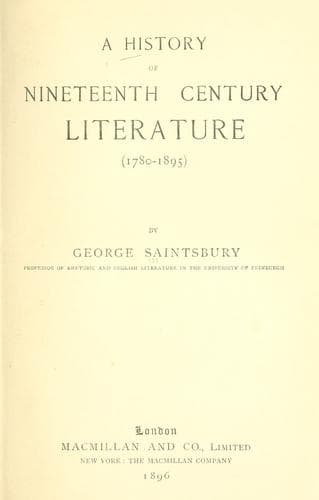
A History of Nineteenth Century Literature (1780-1895)Saintsbury, George
History
A History of Nineteenth Century Literature (1780-1895)
Saintsbury, George
English literature -- 19th century -- History and criticism
And, as indeed follows from this, it was pre-eminently clear. It is
perhaps the clearest style in English that does not, like those of Swift
and Cobbett, deliberately or scornfully eschew rhetorical ornament. What
Macaulay means you never, being any degree short of an idiot, can fail
to understand; and yet he gives you the sense, equipped with a very
considerable amount of preparation and trimming. It would not merely
have been ungrateful, it would have been positively wrong, if his
audience, specially trained as most of them were to his standpoint of
Whig Reformer, had failed to hail him as one of the greatest writers
that had ever been known. Nor would it be much less wrong if judges very
differently equipped and constituted were to refuse him a high place
among great writers.
The characteristics of the _Essays_ reproduce themselves on a magnified
scale so exactly in the _History_ that the foregoing criticism applies
with absolute fidelity to the later and larger, as well as to the
earlier and more minute work. But it would not be quite fair to say that
no new merits appear. There are no new defects; though the difference of
the scope and character of the undertaking intensifies in degree, as
well as magnifies in bulk, the faults of advocacy and of partiality
which have caused the book to be dismissed, with a flippancy only too
well deserved by its own treatment of opponents, as "a Whig pamphlet in
four octavo volumes." Yet the width of study and the grasp of results,
which, though remarkable, were not exactly extraordinary, in the compass
and employed on the subject of a _Review_ article, became altogether
amazing and little short of miraculous in this enlarged field. One of
the earliest and one of the best passages, the view of the state of
England at the death of Charles the Second, may challenge comparison, as
a clearly arranged and perfectly mastered collection of innumerable
minute facts sifted out of a thousand different sources, with anything
in history ancient or modern. The scale of the book is undoubtedly too
great; and if it had been carried, as the author originally intended, to
a date "within the memory of" his contemporaries, it would have required
the life of Old Parr to complete it and the patience of Job to read it
through. The necessity of a hero is a necessity felt by all the nobler
sort of writers. But the choice of William of Orange for the purpose
was, to say the least, unlucky; and the low morality which he had
himself, in an earlier work, confessed as to the statesmen of the period
imparted an additional stimulus to the historian's natural tendency to
be unfair to his political opponents, in the vain hope, by deepening the
blacks, to get a sort of whiteness upon the grays. It has further to be
confessed that independent examination of separate points is not very
favourable to Macaulay's trustworthiness. He never tells a falsehood;
but he not seldom contrives to convey one, and he constantly conceals
the truth.
Public-domain text, read in full here on John Shaqi.
Reviews
Reviews
No reviews yet
Be the first to share your thoughts on this work.
Elsewhere in the archive
Join the Discussion
Join the discussion
Sign in to leave a comment or review.
Sign InorCreate an account