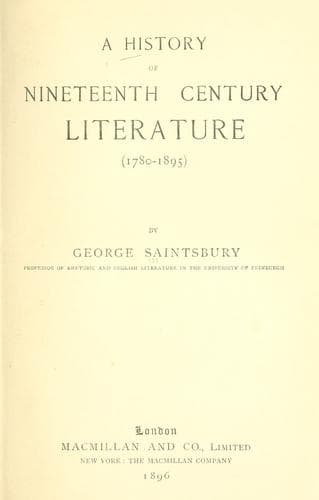
A History of Nineteenth Century Literature (1780-1895)Saintsbury, George
History
A History of Nineteenth Century Literature (1780-1895)
Saintsbury, George
English literature -- 19th century -- History and criticism
Still, the general picture is so vivid and stimulating, the
mastery of materials is so consummate, and the beauty of occasional
passages--the story of Monmouth's Conspiracy, that of James' insane
persecution of Magdalen College, that of the Trial of the Seven Bishops,
that of the Siege of Londonderry--so seductive, that the most hostile
criticism which is not prepared to shut eyes and ears to anything but
faults cannot refuse admiration. And it ought not to be omitted that
Macaulay was practically the first historian who not merely examined the
literature of his subject with unfailing care and attention, but took
the trouble to inspect the actual places with the zeal of a topographer
or an antiquary. That this added greatly to the vividness and
picturesque character of his descriptions need hardly be said; that it
often resulted in a distinct gain to historical knowledge is certain.
But perhaps not its least merit was the putting down in a practically
imperishable form, and in the clearest possible manner, of a vast number
of interesting details which time is only too quick to sweep away. The
face of England has changed more since Macaulay's time, though a bare
generation since, than it had changed in the four or five generations
between the day of his theme and his own; and thus he rescued for us at
once the present and the past.
It is almost impossible to imagine a greater contrast between two
contemporaries of the same nation, both men of letters of the first
rank, than that which exists between Thomas Macaulay and Thomas Carlyle.
In the subjects to which both had affinity there was a rather remarkable
connection. Macaulay's education rather than his sympathies made him
something of a master of at least the formal part of poetry, in which
Carlyle could do nothing. But essentially they were both writers of
prose; they were both men in whom the historico-politico-social
interests were much greater than the purely literary, the purely
artistic, or the purely scientific--though just as Carlyle was a bad
verse-writer or none at all, Macaulay a good one, so Carlyle was a good
mathematician, Macaulay a bad one or none at all. But in the point of
view from which they regarded the subjects with which they dealt, and in
the style in which they treated them, they were poles asunder. Indeed it
may be questioned whether "the style is the point of view" would not be
a better form of the famous deliverance than that which, in full or
truncated form, has obtained currency.
Public-domain text, read in full here on John Shaqi.
Reviews
Reviews
No reviews yet
Be the first to share your thoughts on this work.
Elsewhere in the archive
Join the Discussion
Join the discussion
Sign in to leave a comment or review.
Sign InorCreate an account