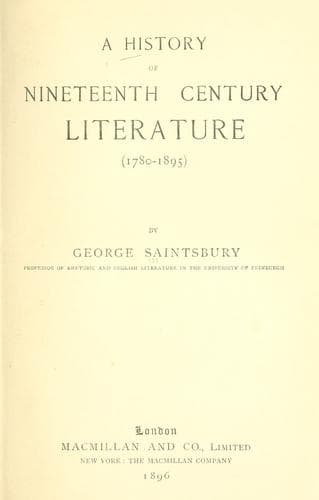
A History of Nineteenth Century Literature (1780-1895)Saintsbury, George
History
A History of Nineteenth Century Literature (1780-1895)
Saintsbury, George
English literature -- 19th century -- History and criticism
On the other hand, for this or that reason,
Mr. Kinglake had taken a violent dislike to the Emperor Napoleon the
Third, and affected, as did some other English Liberals, to consider the
_coup d'etat_ as not merely a dubious piece of statecraft, but a hideous
and abominable crime. Consequently, he abused all those who took part in
it with tedious virulence, which has probably made not a few Englishmen
look on them with much more leniency than they deserved. In short,
Kinglake, with many of the qualities of the craftsman in an
extraordinary degree, was almost entirely deficient in those of the
artist. He served as a favourite example to Mr. Matthew Arnold of the
deficiency of the British literary temper in accomplishment and grace,
and it cannot be denied that Mr. Arnold's strictures were here justified
to an extent which was not always the case when he assumed the office of
censor.
John Forster, who was born a year later than Kinglake, and died fifteen
years before him, was an industrious writer of biographies and
biographical history, the friend of a good many men of letters, editor
for many years of the _Examiner_, and secretary to the Lunacy
Commissioners. He paid particular attention to the period of the
Rebellion; his _Arrest of the Five Members_ being his chief work, among
several devoted to it. He wrote a _Life of Goldsmith_, and began one of
Swift. In contemporary biography his chief performances were lives of
Landor and of Dickens, with both of whom he was extremely intimate. In
private life Forster had the character of a bumptious busybody, which
character indeed the two books just mentioned, even without the
anecdotes abundant in more recent books of biography, abundantly
establish. And towards the men of letters with whom he was intimate
(Carlyle and Browning may be added to Landor and Dickens) he seems to
have behaved like a Boswell-Podsnap, while in the latter half of the
character he no doubt sat to Dickens himself. But he was an
indefatigable literary inquirer, and seems, in a patronising kind of
way, to have been liberal enough of the result of his inquiries. He had
a real interest both in history and literature, and he wrote fairly
enough.
Public-domain text, read in full here on John Shaqi.
Reviews
Reviews
No reviews yet
Be the first to share your thoughts on this work.
Elsewhere in the archive
Join the Discussion
Join the discussion
Sign in to leave a comment or review.
Sign InorCreate an account