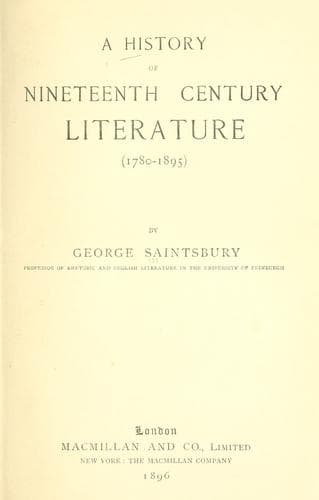
A History of Nineteenth Century Literature (1780-1895)Saintsbury, George
History
A History of Nineteenth Century Literature (1780-1895)
Saintsbury, George
English literature -- 19th century -- History and criticism
One of the most curious figures among the historians of this century was
Henry Thomas Buckle, who was born near Blackheath in 1823, and privately
educated. He had ample means, and was fond of books; and in 1857 he
brought out the first volume (which was followed by a second in 1861) of
a _History of Civilisation_. He did not nearly complete--in fact he only
began--his scheme, in which the European part was ultimately intended to
be subordinate to the English, and he died of typhus at Damascus in May
1862. The book attained at once, and for some time kept, an
extraordinary popularity, which has been succeeded by a rather unjust
depreciation. Both are to be accounted for by the fact that it is in
many ways a book rather of the French than of the English type, and
displays in fuller measure than almost any of Buckle's contemporaries in
France itself, with the possible exception of Taine, could boast, the
frank and fearless, some would say the headlong and headstrong, habit
of generalisation--scorning particulars, or merely impressing into
service such as are useful to it and drumming the others out--on which
Frenchmen pride themselves, and for the lack of which they are apt to
pronounce English historians, and indeed English men of letters of all
kinds, plodding and unilluminated craftsmen rather than artists. In
Buckle's reflections on Spain and Scotland, he accounts for the whole
history of both countries and the whole character of both peoples by
local conditions in the first place, and by forms of civil and
ecclesiastical government. In respect to these last, his views were
crude Voltairianism; but perhaps this is the best and most
characteristic example of his method. He was extremely prejudiced; his
lack of solid disciplinary education made him unapt to understand the
true force and relative value of his facts and arguments; and as his
premises are for the most part capriciously selected facts cemented
together with an untempered mortar of theory, his actual conclusions are
rarely of much value. But his style is clear and vigorous; the
aggressive _raiding_ character of his argument is agreeably stimulating,
and excellent to make his readers clear up their minds on the other
side; while the dread of over-generalisation, however healthy in itself,
has been so long a dominant force in English letters and philosophy that
a little excess the other way might be decidedly useful as an
alterative. The worst fault of Buckle was the Voltairianism above
referred to, causing or caused by, as is always the case, a deplorable
lack of taste, which is not confined to religious matters.
Public-domain text, read in full here on John Shaqi.
Reviews
Reviews
No reviews yet
Be the first to share your thoughts on this work.
Elsewhere in the archive
Join the Discussion
Join the discussion
Sign in to leave a comment or review.
Sign InorCreate an account