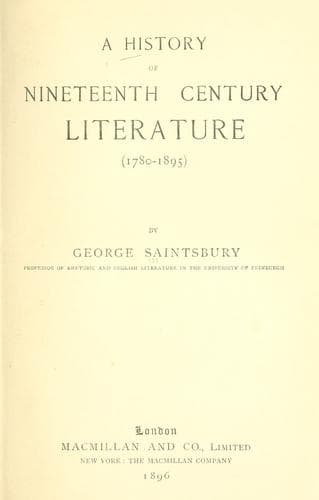
A History of Nineteenth Century Literature (1780-1895)Saintsbury, George
History
A History of Nineteenth Century Literature (1780-1895)
Saintsbury, George
English literature -- 19th century -- History and criticism
In the case of no English poet is it more important and interesting than
in the case of Tennyson, considering the excellence of his own work in
the first place, and the altogether unparalleled extent of his influence
in the second, to trace the nature and character of his poetical
quality. Nor is this difficult, though strange to say it has not always
been done. In his very earliest work, so soon as this quality appeared
at all, it is to be discovered side by side with other things which are
not native. Undoubtedly the tradition which, in the general filiation
of English poetry, connects Tennyson with Keats, is not wholly wrong.
In many of the weaker things, and not a few of the better, of the
volumes of 1830 and 1832, there is to be seen both the wonderful music
which Keats attained by a combination of the classical and romantic
appeals--the appeals which in his own case are singly exhibited at their
best in the "Grecian Urn" and in "La Belle Dame sans Merci,"--and the
sometimes faulty and illegitimate means which Keats took to produce this
effect. But to any one who compares rationally (and it may be permitted
to remark parenthetically, that nothing seems to be more misunderstood
than the comparative point of view) the difference between Keats and
Tennyson will emerge at once. Both being great poets, there is the
inexplicable in both; while as Keats undoubtedly died before he had any
chance of applying to his own powers and products the unequalled process
of clarifying and self-criticism which went on with Tennyson in the ten
years' silence between the second of the volumes just mentioned and his
issue of 1842, it is impossible to say that Keats himself could not have
done something similar. Nothing that he ever did is worse in point of
"gush," of undisciplined fluency, of mistakes in point of taste and of
other defects than the notorious piece about "the darling little room,"
on which the future Poet Laureate's critics were so justly severe; while
in the single point of passion it is very doubtful whether Tennyson ever
approached the author of "La Belle Dame sans Merci." There was not
perhaps much to choose between the two in their natural power of
associating pictorial with musical expression; while both had that gift
of simple humanity, of plain honest healthy understanding of common
things, the absence of which gives to Shelley--in some ways a greater
poet than either of them--a certain unearthliness and unreality.
Public-domain text, read in full here on John Shaqi.
Reviews
Reviews
No reviews yet
Be the first to share your thoughts on this work.
Elsewhere in the archive
Join the Discussion
Join the discussion
Sign in to leave a comment or review.
Sign InorCreate an account