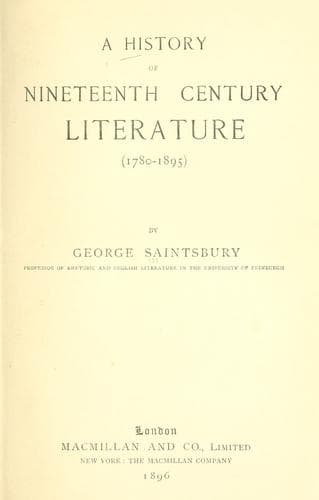
A History of Nineteenth Century Literature (1780-1895)Saintsbury, George
History
A History of Nineteenth Century Literature (1780-1895)
Saintsbury, George
English literature -- 19th century -- History and criticism
But Tennyson had from the first a wider range of interest and capacity
than Keats, and he had the enormous advantage of thorough and regular
literary training. No poet ever improved his own work as Tennyson did;
nor has any, while never allowing his genius to be daunted by
self-comparison with his predecessors, had such a faculty of availing
himself of what they had done without copying, of seeing what they had
not done and supplying the gap himself. And besides this he had the
inexplicable, the incommunicable, the unique, the personal gift. In the
very earliest things, in "Claribel," in "Mariana," in the "Recollections
of the Arabian Nights," in the "Ode to Memory," in the "Dirge," in the
"Dying Swan," in "Oriana," there is even to those who were born long
after they were written, even to those who have for years sedulously
compared them with almost all things before and with all things since,
the unmistakable note of the new, of the new that never can be old. It
is there in the rhythms, it is there in the phrase. The poet may take
things that had previously existed--the Keatsian and Shelleian lyric,
the Wordsworthian attitude to Nature, the Miltonic blank verse; but
inevitably, invariably, each under his hands becomes different, becomes
individual and original. The result cannot be accounted for by
mannerisms, from which at no time was Tennyson free, and after the
thousands and ten thousands of imitations which have been seen since, it
stands out untouched, unrivalled.
In the next instalment this quality of intense poetical individuality
strengthened and deepened. As we read "The Two Voices," "Oenone," "The
Palace of Art," "The Lotos Eaters," "A Dream of Fair Women," it becomes
almost incomprehensible how any one who ever read them even in forms
less perfect than those that we possess, should have mistaken their
incomparable excellence. But the student of literary history knows
better. He knows that nearly always the poet has to create his audience,
that he sings before the dawn of the day in which he is to be sovereign.
Public-domain text, read in full here on John Shaqi.
Reviews
Reviews
No reviews yet
Be the first to share your thoughts on this work.
Elsewhere in the archive
Join the Discussion
Join the discussion
Sign in to leave a comment or review.
Sign InorCreate an account