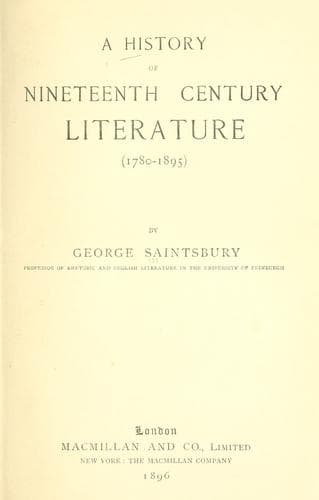
A History of Nineteenth Century Literature (1780-1895)Saintsbury, George
History
A History of Nineteenth Century Literature (1780-1895)
Saintsbury, George
English literature -- 19th century -- History and criticism
Although, as has been said, the popularity of Lord Tennyson itself was
not a plant of very rapid growth, and though but a short time before his
position was undisputed it was admitted only by a minority, imposing in
quality but far from strong in mere numbers, his chief rival during the
latter part of their joint lives was vastly slower in gaining the public
ear. It is not quite pleasant to think that the well-merited but
comparatively accidental distinction of the Laureateship perhaps did
more even for Tennyson in this respect than the intrinsic value of his
work. Robert Browning had no such aid, his verse was even more
abhorrent than Tennyson's to the tradition of the elders, and until he
found a sort of back-way to please, he was even more indifferent to
pleasing. So that while Tennyson became in a manner popular soon after
1850, two decades more had to pass before anything that could be called
popularity came to Browning. It is, though the actual dates are well
enough known to most people, still something of a surprise to remember
that at that time he had been writing for very nearly forty years, and
that his first book, though a little later than Tennyson's, actually
appeared before the death of Coleridge and not more than a few months
after that of Scott. Browning, about whose ancestry and parentage a good
deal of mostly superfluous ink has been shed, was born, the son of a
city man, on 7th May 1812, in the, according to the elder Mr. Weller,
exceptional district of Camberwell. He was himself exceptional enough in
more ways than one. His parents had means; but Browning did not receive
the ordinary education of a well-to-do Englishman at school and college,
and his learning, though sufficiently various, was privately obtained.
_Pauline_, his first poem, appeared in 1833, but had been written about
two years earlier. He did not reprint it in the first general collection
of his verse, nor till after his popularity had been established; and it
cannot be said to be of great intrinsic excellence. But it was
distinctly characteristic:--first, in a strongly dramatic tone and
strain without regular dramatic form; secondly, in a peculiar fluency of
decasyllabic verse that could not be directly traced to any model; and,
thirdly, in a certain quality of thought, which in later days for a long
time received, and never entirely lost from the vulgar, the name of
"obscurity," but which perhaps might be more justly termed
breathlessness--the expression, if not the conception, of a man who
either did not stop at all to pick his words, or was only careful to
pick them out of the first choice that presented itself to him of
something not commonplace.
Public-domain text, read in full here on John Shaqi.
Reviews
Reviews
No reviews yet
Be the first to share your thoughts on this work.
Elsewhere in the archive
Join the Discussion
Join the discussion
Sign in to leave a comment or review.
Sign InorCreate an account