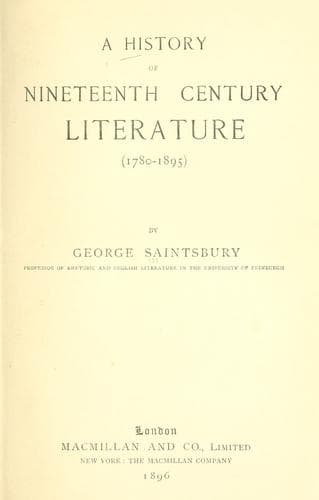
A History of Nineteenth Century Literature (1780-1895)Saintsbury, George
History
A History of Nineteenth Century Literature (1780-1895)
Saintsbury, George
English literature -- 19th century -- History and criticism
In _Pauline_, however, there is little positive beauty. In the next
book, _Paracelsus_ (1835), there is a great deal. Here the dramatic form
was much more definite, though still not attempting acted or actable
drama. The poet's appetite for "soul-dissection" was amply shown in the
characters not merely of Paracelsus himself, but of his soberer friends
Festus and Michal, and of the Italian poet Aprile, a sort of Euphorion
pretty evidently suggested by, though greatly enlarged from, the actual
Euphorion of the second part of _Faust_, then not long finished. The
rapid, breathless blank verse, the crowding rush of simile and
illustration, and the positive plethora of meaning, more often glanced
and hinted at than fully worked out, were as noteworthy as before in
kind, and as much more so in degree as in scale. Here too were lyrics,
not anticipating the full splendour of the poet's later lyrical verse,
but again quite original. Here, in fact, to anybody who chose to pay
attention, was a real "new poet" pretty plainly announced.
Very few did choose to pay attention; and Browning's next attempt was
not of a kind to conciliate halting or hostile opinion, though it might
please the initiated. He wrote for his friend Macready a play intended
at least to be of the regular acting kind. This play, _Strafford_
(1837), contains fine things; but the involution and unexpectedness of
the poet's thought now and always showed themselves least engagingly
when they were even imagined as being spoken not read. After yet another
three years _Sordello_ followed, and here the most peculiar but the
least estimable side of the author's genius attained a prominence not
elsewhere equalled, till in his latest stage he began to parody himself,
and scarcely even then. Although this book does not deserve the
disgusted contempt which used to be poured on it, though it contains
many noble passages, and as the "story of a soul" is perfectly
intelligible to moderate intellects, it must have occasioned some doubts
and qualms to intelligent admirers of the poet as to whether he would
lose himself in the paths on which he was entering. Such doubts must
have been soon set at rest by the curious medley issued in parts, under
the general title of _Bells and Pomegranates_, between 1841 and 1846.
The plays here, though often striking and showing that the author's
disabilities, though never likely to leave, were also not likely to
master him, showed also, with the possible exception of the charming
nondescript of _Pippa Passes_, no new or positively unexpected faculty.
But certain shorter things, lyrical and other, at last made it clear
that Browning could sing as well as say: and from this time, 1846 (which
also was the year of his marriage with Miss Elizabeth Barrett), he could
claim rank as a great poet. He had been hitherto more or less a
wanderer, but with headquarters in England; he now went to Florence,
which in turn was his headquarters till his wife's death in 1861. His
Public-domain text, read in full here on John Shaqi.
Reviews
Reviews
No reviews yet
Be the first to share your thoughts on this work.
Elsewhere in the archive
Join the Discussion
Join the discussion
Sign in to leave a comment or review.
Sign InorCreate an account