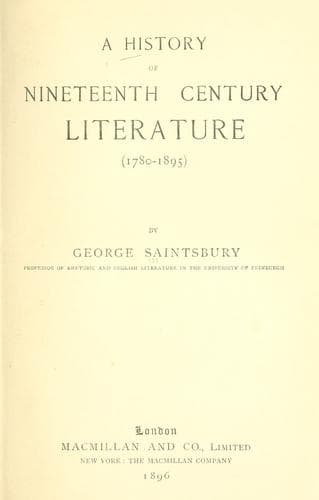
A History of Nineteenth Century Literature (1780-1895)Saintsbury, George
History
A History of Nineteenth Century Literature (1780-1895)
Saintsbury, George
English literature -- 19th century -- History and criticism
But though no competent lover of poetry can ever have denied the truth
and cogency of these objections, the admission of them can never, in any
competent lover of poetry, have obscured or prevented an admiration of
Browning none the less intense because not wholly unreserved. Even his
longer poems, in which his faults were most apparent, possessed an
individuality of the first order, combined the intellectual with no
small part of the sensual attraction of poetry after a fashion not
otherwise paralleled in England since Dryden, and provided an
extraordinary body of poetical exercise and amusement. The pathos, the
power, at times the humour, of the singular soul-studies which he was so
fond of projecting with little accessory of background upon his canvas,
could not be denied, and have not often been excelled. If he was not
exactly what is commonly called orthodox in religion, and if his
philosophy was of a distinctly vague order, he was always "on the side
of the angels" in theology, in metaphysics, in ethics; and his politics,
if exceedingly indistinct and unpractical, were always noble and
generous. Further, though he seems to have been utterly destitute of the
slightest gift of dramatic construction, he had no mean share of a much
rarer gift, that of dramatic character; and in a century of descriptions
of nature his, if not the most exquisite, have a freedom and truth, a
largeness of outline combined with felicity of colour, not elsewhere to
be discovered.
But it is as a lyric poet that Browning ranks highest; and in this
highest class it is impossible to refuse him all but the highest rank,
in some few cases the very highest. He understood love pretty
thoroughly; and when a lyric poet understands love thoroughly there is
little doubt of his position. But he understood many other things as
well, and could give strange and delightful voice to them. Even his
lyrics, still more his short non-lyrical poems, admirable as they often
are, and closely as they group with the lyrics proper, are not untouched
by his inseparable defect. He cannot be prevented from inserting now and
then in the midst of exquisite passages more or fewer of his quirks and
cranks of thought and phrase, of his vernacularity or his euphuism, of
his outrageous rhymes (which, however, are seldom or never absolutely
bad), of those fantastic tricks of his in general which remind one of
nothing so much as of dashing a bladder with rattling peas in the
reader's face just at the height of the passion or the argument.
Public-domain text, read in full here on John Shaqi.
Reviews
Reviews
No reviews yet
Be the first to share your thoughts on this work.
Elsewhere in the archive
Join the Discussion
Join the discussion
Sign in to leave a comment or review.
Sign InorCreate an account