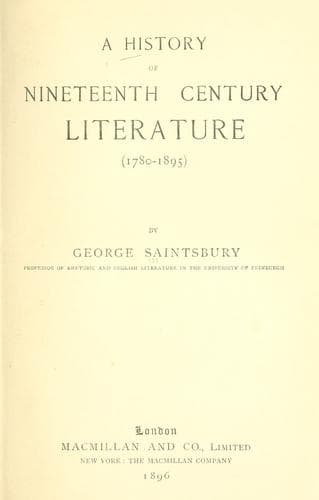
A History of Nineteenth Century Literature (1780-1895)Saintsbury, George
History
A History of Nineteenth Century Literature (1780-1895)
Saintsbury, George
English literature -- 19th century -- History and criticism
Yet the beauty, the charm, the variety, the vigour of these short poems
are as wonderful as the number of them. He never lost the secret of them
to his latest years. The delicious lines "Never the time and the place,
And the loved one all together" are late; and there are half a dozen
pieces in _Asolando_, latest of all, which exhibit to the full the
almost bewildering beauty of combined sound, thought, and sight, the
clash of castanets and the thrill of flutes, the glow of flower and
sunset, the subtle appeal for sympathy in feeling or assent in judgment.
The song snatches in _Pippa Passes_, "Through the Metidja," "The Lost
Leader," "In a Gondola," "Earth's Immortalities," "Mesmerism," "Women
and Roses," "Love Among the Ruins," "A Toccata of Galuppis," "Prospice,"
"Rabbi Ben Ezra," "Porphyria's Lover," "After," with scores of others,
and the "Last Ride Together," the poet's most perfect thing, at the head
of the list, are such poems as a very few--Shakespeare, Shelley, Burns,
Coleridge--may surpass now and then in pure lyrical perfection, as
Tennyson may excel in dreamy ecstasy, as some seventeenth century
songsters may outgo in quaint and perfect fineness of touch, but such as
are nowhere to be surpassed or equalled for a certain volume and variety
of appeal, for fulness of life and thought, of action and passion.
Mr. Browning's wife, Elizabeth Barrett, was older than himself by six
years, and her period of popularity considerably anticipated his. But
except one very juvenile book she published nothing of importance till
1838, when Browning, whom she did not then know, had already manifested
his idiosyncrasy. Miss Barrett, whose father's original name was
Moulton, was born at Carlton Hall, Durham, on 6th March 1806. The change
of name was brought on by succession to estates in the West Indies; and
the family were wealthy. For the greater part of Miss Barrett's youth
they lived in Herefordshire at a place, Hope End, which has left great
traces on her early poetry; later her headquarters were in London, with
long excursions to Devonshire. These excursions were mainly caused by
bad health, from which, as well as from family bereavements, Miss
Barrett was a great sufferer. She had read widely; she began to write as
a mere child; and her studies extended even to Greek, though in a rather
amateurish and desultory fashion. Her _Essay on Mind_ and other poems
appeared in 1825; but a considerable interval, as noted above, elapsed
before, in _The Seraphim_ and other poems, she gave, if not a truer, a
more characteristic note. And two more intervals of exactly the same
length gave _Poems_ 1846 and _Poems_ 1850, containing most of her best
work. Meanwhile she had met Robert Browning, and had married him, rather
against the wish of her family, in 1846. The rest of her life was spent
mostly at Florence, where, in 1849, the only child of the marriage was
born. Two years later appeared _Casa Guidi Windows_ and the long
Public-domain text, read in full here on John Shaqi.
Reviews
Reviews
No reviews yet
Be the first to share your thoughts on this work.
Elsewhere in the archive
Join the Discussion
Join the discussion
Sign in to leave a comment or review.
Sign InorCreate an account