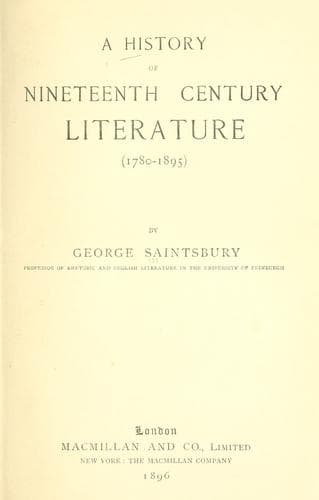
A History of Nineteenth Century Literature (1780-1895)Saintsbury, George
History
A History of Nineteenth Century Literature (1780-1895)
Saintsbury, George
English literature -- 19th century -- History and criticism
These poems had a certain advantage in being presented to a public
already acquainted with the work of Mr. Morris and Mr. Swinburne; but
Rossetti was not merely older than his two friends, he was also to some
extent their master. At the same time the influences which acted on him
were naturally diverse from those which, independently of his own
influence, acted on them. For the French and English mediaeval
inspirations of Mr. Morris, for the classical and general study of Mr.
Swinburne, he had his ancestral Italians almost for sole teachers; and
for their varied interests he had his own art of painting for a
continual companion, reminder, and model. Yet the mediaeval impulse is
almost equally strong on all three, and its intensity shows that it was
the real dominant of the moment in English poetry. The opening poem of
Rossetti's first book, "The Blessed Damozel," which is understood to
have been written very early, though afterwards wrought up by touches
both of his love for his wife while living and of his regret for her
when dead, is almost a typical example of the whole style and school,
though it is individualised by the strong pictorial element rarely
absent from his work. The "Blessed Damozel" herself, who "leaned out
From the gold Bar of Heaven," is a figure from the _Paradiso_, divested
of the excessive abstraction of that part of Dante, and clothed partly
in the gayer colours and more fleshly personality of English and French
mediaevalism, partly in a mystical halo which is peculiar to these
nineteenth century re-creations of mediaeval thought and feeling. The
poem is of extreme beauty, and ornate as is its language in parts there
are touches, such as the poet's reflection
To one it is ten years of years,
which utter the simplest truth and tenderness; while others, such as the
enumeration of the Virgin's handmaidens (over which at the time the
hoofs of earless critics danced)--
With her five handmaidens, whose names
Are five sweet symphonies--
Cecily, Gertrude, Magdalen,
Margaret and Rosalys--
are consummate triumphs of the word-music brought by Tennyson into
English poetry. Indeed this couplet of names might be made a sort of
text to expound the great appeal to the ear of this kind of poetry,
which any one who is deaf to the exceptional and golden harmony of the
arrangement need never hope to appreciate. It is perfectly easy to
change the order in many ways without affecting the verse; there is
absolutely none of these combinations which approaches the actual one in
beauty of sound and suggestion.
Public-domain text, read in full here on John Shaqi.
Reviews
Reviews
No reviews yet
Be the first to share your thoughts on this work.
Elsewhere in the archive
Join the Discussion
Join the discussion
Sign in to leave a comment or review.
Sign InorCreate an account