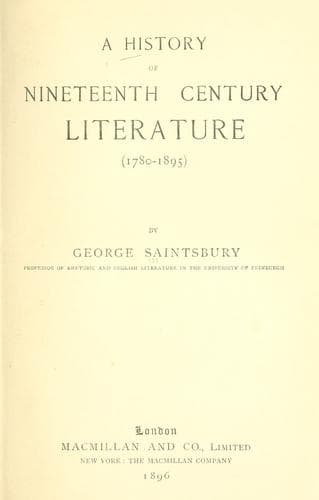
A History of Nineteenth Century Literature (1780-1895)Saintsbury, George
History
A History of Nineteenth Century Literature (1780-1895)
Saintsbury, George
English literature -- 19th century -- History and criticism
"Love's Nocturn" which follows is more of the early Italian school pure
and simple; and "Troy Town," a ballad with burdens, is one of a class of
poem much affected by Rossetti and ever since, which has produced some
admirable work, but is perhaps a little open to the charge of too
deliberate archaism. It is at any rate far inferior to his own "Sister
Helen." But "The Burden of Nineveh" which follows is in a quite
different style, and besides its intrinsic excellence is noteworthy as
showing how very far Rossetti was from being limited in his choice of
manners. But to go through the whole contents of this very remarkable
volume would be impossible, and we can only particularise the great
sonnet-sequence "The House of Life" (which was attacked for want of
decency with as little intelligence as "The Blessed Damozel" had been
attacked for want of sense), and a set "for pictures." The first,
somewhat thorny and obscure in language, is of extreme poetical and
philosophical beauty. The latter, beautiful enough, may be said to lend
themselves a little to the attacks of those critics who charged Rossetti
with, in the Aristotelian phrase, "shifting his ground to another kind"
or (to vary the words) of taking the quotation _ut pictura poesis_ in
too literal a sense. Some songs, especially "Penumbra" and "The
Woodspurge," of intense sweetness and sadness, were also included; and
the simple directness of "Jenny" showed, like "Nineveh," capacities in
the poet not easily to be inferred from the bulk of his poems.
Rossetti's second volume, while it added only too little to the bulk of
his work--for much of it consisted of a revised issue of "The House of
Life"--added greatly to its enjoyment. But it produced no new kind,
unless certain extensions of the ballad-scheme into narrative poems of
considerable length--"Rose-Mary," "The White Ship," and "The King's
Tragedy"--be counted as such. "Rose-Mary" in particular exhibits the
merits and defects of the poet in almost the clearest possible light,
and it may be safely said that no English poet, not the very greatest,
need have been ashamed of such a stanza as this, where there is no
affectation worth speaking of, where the eternal and immortal
commonplaces of poetry are touched to newness as only a master touches,
and where the turn of the phrase and verse is impeccable and supreme:--
And lo! on the ground Rose-Mary lay,
With a cold brow like the snows ere May,
With a cold breast like the earth till Spring--
With such a smile as the June days bring
When the year grows warm for harvesting.
Public-domain text, read in full here on John Shaqi.
Reviews
Reviews
No reviews yet
Be the first to share your thoughts on this work.
Elsewhere in the archive
Join the Discussion
Join the discussion
Sign in to leave a comment or review.
Sign InorCreate an account