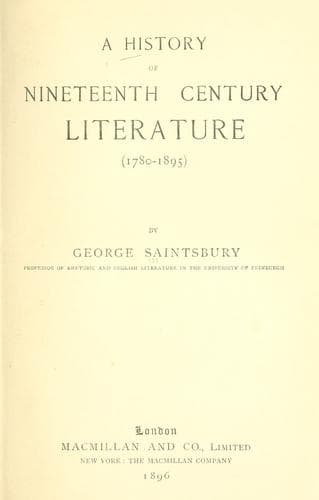
A History of Nineteenth Century Literature (1780-1895)Saintsbury, George
History
A History of Nineteenth Century Literature (1780-1895)
Saintsbury, George
English literature -- 19th century -- History and criticism
Rossetti's younger, but very little younger, sister, Christina Georgina,
was born in 1830, sat to her brother early for the charming picture of
"The Girlhood of Mary Virgin," and is said also to figure in his
illustration of the weeping queens in Tennyson's _Morte D' Arthur_. But
she lived an exceedingly quiet life, mainly occupied in attention to her
mother and in devotion; for she had been brought up, and all her life
remained, a member of the Church of England. Her religious feelings more
and more coloured her poetical work, which was produced at intervals
from 1861 till close upon her death in the winter of 1894-95. It was not
hastily written, and latterly formed mainly the embellishment of certain
prose books of religious reflection or excerpt. But it was always of an
exquisite quality. Its first expression in book form was _Goblin Market,
and other Poems_ (1861), which, as well as her next volume, _The
Prince's Progress_ (1866), was illustrated by her brother's pencil. A
rather considerable time then passed without anything of importance (a
book called _Sing-Song_ excepted), till in 1881 _A Pageant, and other
Poems_ was added. A collection of all these was issued nine years later,
but with this the gleanings from the devotional works above mentioned
(the chief of which were _Time Flies_ and _The Face of the Deep_) have
still to be united.
There are those who seriously maintain Miss Rossetti's claim to the
highest rank among English poetesses, urging that she excels Mrs.
Browning, her only possible competitor, in freedom from blemishes of
form and from the liability to fall into silliness and maudlin gush, at
least as much as she falls short of her in variety and in power of
shaping a poem of considerable bulk. But without attempting a too rigid
classification we may certainly say that Miss Rossetti has no superior
among Englishwomen who have had the gift of poetry. In the title-piece
of her first book the merely quaint side of Prae-Raphaelitism perhaps
appears rather too strongly, though very agreeably to some. But
"Dreamland," "Winter Rain," "An End," "Echo," the exquisite song for
music "When I am dead, my dearest," and the wonderful devotional pieces
called "The Three Enemies" and "Sleep at Sea," with many charming
sonnets, adorned a volume which, on the whole, showed more of the
tendencies of the school than any which had yet appeared. For it was
less exclusively mediaeval than Mr. Morris' _Defence of Guinevere_, and
very much more varied as well as more mature than Mr. Swinburne's _Queen
Mother_ and _Rosamond_. _The Prince's Progress_ showed a great advance
on _Goblin Market_ in dignity and freedom from mannerism, and the minor
poems in general rivalled those in the earlier collection, though the
poetess perhaps never quite equalled "Sleep at Sea." The contents of _A
Pageant, and other Poems_ were at once more serious and lighter than
those of the two former books (for Miss Rossetti, like her brother, had
Public-domain text, read in full here on John Shaqi.
Reviews
Reviews
No reviews yet
Be the first to share your thoughts on this work.
Elsewhere in the archive
Join the Discussion
Join the discussion
Sign in to leave a comment or review.
Sign InorCreate an account