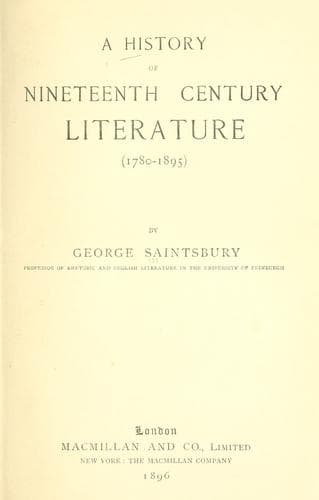
A History of Nineteenth Century Literature (1780-1895)Saintsbury, George
History
A History of Nineteenth Century Literature (1780-1895)
Saintsbury, George
English literature -- 19th century -- History and criticism
Here, as elsewhere, it has seemed better to postpone most of the
necessary general criticism of schools and groups till the concluding
chapter, but in this particular respect the paucity of individuals which
our scheme leaves (though Miss Rossetti and Mr. O'Shaughnessy will give
valuable assistance presently), may make a few words desirable, even if
they be partly repetition and partly anticipation. We find in Rossetti a
strong influence of pictorial on poetic art; an overpowering tendency to
revert to the forms and figures, the sense and sentiment of the past,
especially the mediaeval past; and a further tendency to a mysticism
which is very often, if not always, poetic in character, as indeed
mysticism generally if not always is. We find in point of form a
distinct preference for lyric over other kinds, a fancy for archaic
language and schemes of verse, a further fancy for elaborate and ornate
language (which does not, however, exclude perfect simplicity when the
poet chooses), and above all, a predilection for attempting and a
faculty for achieving effects of verbal music by cunning adjustment of
vowel and consonant sound which, though it had been anticipated
partially, and as it were accidentally in the seventeenth century, and
had been after the Romantic revival displayed admirably by Coleridge and
Keats, and brought to a high pitch by Tennyson, was even further
elaborated and polished by the present school. Indeed, they may be said
to have absolutely finished this poetical appeal as a distinct and
deliberate one. All poets have always attempted, and all poets always
will attempt, and when they are great, achieve these enchanting effects
of mere sound. But for some considerable time it will not be possible
(indeed it will be quite impossible until the structure, the intonation,
the phrase of English have taken such turns as will develop physical
possibilities as different from those of our language as ours are from
those of the seventeenth century) for any poets to get distinctly great
effects in the same way. It is proof enough of this that, except the
masters, no poet for many years now _has_ achieved a great effect by
this means, and that the most promising of the newer school, whether
they may or may not have found a substitute, are abandoning it.
Public-domain text, read in full here on John Shaqi.
Reviews
Reviews
No reviews yet
Be the first to share your thoughts on this work.
Elsewhere in the archive
Join the Discussion
Join the discussion
Sign in to leave a comment or review.
Sign InorCreate an account