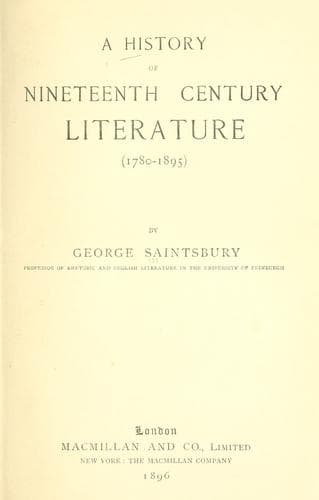
A History of Nineteenth Century Literature (1780-1895)Saintsbury, George
History
A History of Nineteenth Century Literature (1780-1895)
Saintsbury, George
English literature -- 19th century -- History and criticism
Helen Maria Williams, with Young and Moore, is our chief English witness
for the state of France and Paris just before and during the early years
of the Revolution. She was one of Johnson's girl pets in his latest
years, but Boswell is certainly justified in suggesting that if the sage
had lived a little longer he would certainly not have repeated his
elegant compliment: "If I am so ill when you are near, what should I be
when you are away?" She outlived this phase also of her life, and did
not die till 1828, being then sixty-five. Even in the early days she had
been a Girondist, not a Jacobin; but she happened to live in Paris
during the outbreak of the Revolution, wrote _Letters from France_,
which had a great popularity, and was hand in glove with most of the
English and Irish revolutionary leaders. Wolfe Tone in his diary speaks
of her as "Miss Jane Bull completely," but neither prudery nor
patriotism would have struck persons less prejudiced than the leader of
the United Irishmen as the leading points of Helen Maria. Her poems,
published in 1786, during her pre-revolutionary days, are dedicated to
Queen Charlotte, and nearly half the first of the two pretty little
volumes (which have a horrific frontispiece of the Princes in the Tower,
by Maria Cosway) is occupied by a stately list of subscribers, with the
Prince of Wales at their head. They have little merit, but are not
uninteresting for their "signs of the times": sonnets, a tale called
_Edwin and Eltruda_, an address to Sensibility, and so forth. But the
longest, _Peru_, is in the full eighteenth century couplet with no sign
of innovation. The _Letters from France_, which extend to eight volumes,
possess, besides the interest of their subject, the advantage of a more
than fair proficiency on the author's part in the formal but not
ungraceful prose of her time, neither unduly Johnsonian nor in any way
slipshod. But it may perhaps be conceded that, but for the interest of
the subject, they would not be of much importance.
Public-domain text, read in full here on John Shaqi.
Reviews
Reviews
No reviews yet
Be the first to share your thoughts on this work.
Join the Discussion
Join the discussion
Sign in to leave a comment or review.
Sign InorCreate an account