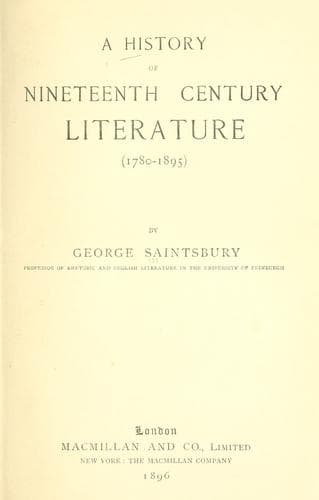
A History of Nineteenth Century Literature (1780-1895) — John Shaqi
A History of Nineteenth Century Literature (1780-1895)Saintsbury, George
History
A History of Nineteenth Century Literature (1780-1895)
Saintsbury, George
English literature -- 19th century -- History and criticism
The coarse and violent expression, as well as the unpopular matter, of
Paine's works may have led to his being rather unfairly treated in the
hot fights of the Revolutionary period; but the attempts which have
recently been made to whitewash him are a mere mistake of reaction, or
paradox, or pure stupidity. The charges which used to be brought against
his moral character matter little; for neither side in these days had,
or in any days has, a monopoly of loose or of holy living. But two facts
will always remain: first, that Paine attacked subjects which all
require calm, and some of them reverent, treatment, in a tone of the
coarsest violence; and, secondly, that he engaged in questions of the
widest reach, and requiring endless thought and reading, with the scanty
equipments and the superabundant confidence of a self-educated man. No
better instance of this latter characteristic could be produced or
required than a sentence in the preface to the second part of the _Age
of Reason_. Here Paine (who admitted that he had written the first part
hastily, in expectation of imprisonment, without a library, and without
so much as a copy of the Scriptures he was attacking at hand, and who
further confessed that he knew neither Hebrew nor Greek nor even Latin)
observes: "I have produced a work that no Bible-believer, though writing
at his ease and with a library of Church books about him, can refute."
In this charming self-satisfaction, which only natural temper assisted
by sufficient ignorance can attain in perfection, Paine strongly
resembles his disciple Cobbett. But the two were also alike in the
effect which this undoubting dogmatism, joined to a very clear, simple,
and forcible style, less correct in Paine's case than in Cobbett's,
produced upon readers even more ignorant than themselves, and greatly
their inferiors in mental strength and literary skill. Paine, indeed,
was as much superior to Cobbett in logical faculty as he was his
inferior in range of attainments and charm of style; while his ignorance
and his arbitrary assumption and exclusion of premises passed unnoticed
by the classes whom he more particularly addressed. He was thus among
the lower and lower middle classes by far the most formidable propagator
of anarchist ideas in religion and politics that England produced; and
his influence lasted till far into the present century, being, it is
said, only superseded by new forms of a similar spirit. But he never
could have had much on persons of education, unless they were prepared
to sympathise with him, or were of singularly weak mind.
Public-domain text, read in full here on John Shaqi.
Reviews
Reviews
No reviews yet
Be the first to share your thoughts on this work.
Join the Discussion
Join the discussion
Sign in to leave a comment or review.
Sign InorCreate an account