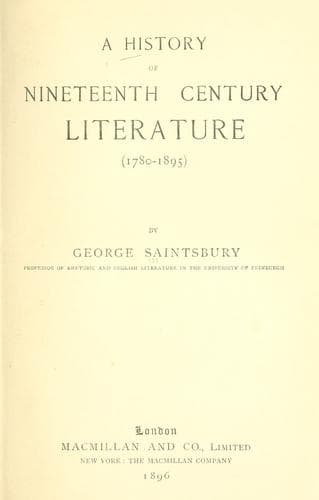
A History of Nineteenth Century Literature (1780-1895)Saintsbury, George
History
A History of Nineteenth Century Literature (1780-1895)
Saintsbury, George
English literature -- 19th century -- History and criticism
It is very different with his poetry. Here, too, the disastrous, the
almost ruinous results of his weaknesses appear. When one begins to sift
and riddle the not small mass of his verse, it shrinks almost
appallingly in bulk. _Wallenstein_, though better than the original, is
after all only a translation. _Remorse_ (either under that name or as
_Osorio_) and _Zapolya_ are not very much better than the contemporary
or slightly later work of Talfourd and Milman. _The Fall of Robespierre_
is as absurd and not so amusing as Southey's unassisted _Wat Tyler_. Of
the miscellaneous verse with which, after these huge deductions, we are
left, much is verse-impromptu, often learned and often witty, for
Coleridge was (in early days at any rate) abundantly provided with both
wit and humour, but quite occasional. Much more consists of mere
Juvenilia. Even of the productions of his best times (the last lustrum
of the eighteenth century and a lucid interval about 1816) much is not
very good. _Religious Musings_, though it has had its admirers, is
terribly poor stuff. _The Monody on the Death of Chatterton_ might have
been written by fifty people during the century before it. _The Destiny
of Nations_ is a feeble rant; but the _Ode on the Departing Year_,
though still unequal, still conventional, strikes a very different note.
_The Three Graves_, though injured by the namby-pambiness which was
still thought incumbent in ballads, again shows no vulgar touch. And
then, omitting for the moment _Kubla Khan_, which Coleridge said he
wrote in 1797, but of which no mortal ever heard till 1816, we come to
_The Rime of the Ancient Mariner_ and the birth of the new poetry in
England. Here the stutters and flashes of Blake became coherent speech
and steady blaze; here poetry, which for a century and a half had been
curbing her voice to a genteel whisper or raising it only to a forensic
declamation, which had at best allowed a few wood-notes to escape here
and there as if by mistake, spoke out loud and clear.
Public-domain text, read in full here on John Shaqi.
Reviews
Reviews
No reviews yet
Be the first to share your thoughts on this work.
Elsewhere in the archive
Join the Discussion
Join the discussion
Sign in to leave a comment or review.
Sign InorCreate an account