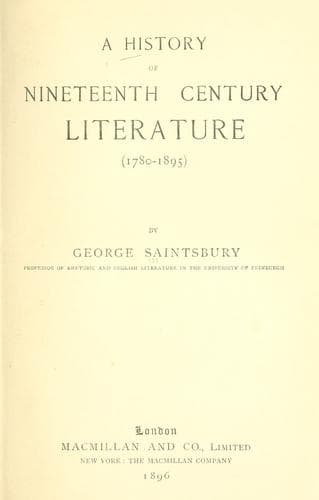
A History of Nineteenth Century Literature (1780-1895)Saintsbury, George
History
A History of Nineteenth Century Literature (1780-1895)
Saintsbury, George
English literature -- 19th century -- History and criticism
If this statement seems exaggerated (and it is certain that at the time
of the appearance of the _Ancient Mariner_ not even Wordsworth, not even
Southey quite relished it, while there has always been a sect of
dissidents against it), two others will perhaps seem more extravagant
still. The second is that, with the exception of this poem, of _Kubla
Khan_, of _Christabel_, and of _Love_, all of them according to
Coleridge written within a few months of each other in 1797-98, he never
did anything of the first class in poetry. The third is that these
four--though _Christabel_ itself does not exceed some fifteen hundred
lines and is decidedly unequal, though the _Ancient Mariner_ is just
over six hundred and the other two are quite short--are sufficient
between them to rank their author among the very greatest of English
poets. It is not possible to make any compromise on this point; for upon
it turns an entire theory and system of poetical criticism. Those who
demand from poetry a "criticism of life," those who will have it that
"all depends on the subject," those who want "moral" or "construction"
or a dozen other things,--all good in their way, most of them
compatible with poetry and even helpful to it, but none of them
essential thereto,--can of course never accept this estimate. Mrs.
Barbauld said that _The Ancient Mariner_ was "improbable"; and to this
charge it must plead guilty at once. _Kubla Khan_, which I should rank
as almost the best of the four, is very brief, and is nothing but a
dream, and a fragment of a dream. _Love_ is very short too, and is
flawed by some of the aforesaid namby-pambiness, from which none of the
Lake school escaped when they tried passion. _Christabel_, the most
ambitious if also the most unequal, does really underlie the criticism
that, professing itself to be a narrative and holding out the promise of
something like a connected story, it tells none, and does not even offer
very distinct hints or suggestions or what its story, if it had ever
been told, might have been. A thousand faults are in it; a good part of
the thousand in all four.
But there is also there something which would atone for faults ten
thousand times ten thousand; there is what one hears at most three or
four times in English, at most ten or twelve times in all
literature--the first note, with its endless echo-promise, of a new
poetry. The wonderful cadence-changes of _Kubla Khan_, its phrases,
culminating in the famous distich so well descriptive of Coleridge
himself--
For he on honey dew hath fed,
And drunk the milk of Paradise,
the splendid crash of the
Ancestral voices prophesying war,
Public-domain text, read in full here on John Shaqi.
Reviews
Reviews
No reviews yet
Be the first to share your thoughts on this work.
Elsewhere in the archive
Join the Discussion
Join the discussion
Sign in to leave a comment or review.
Sign InorCreate an account