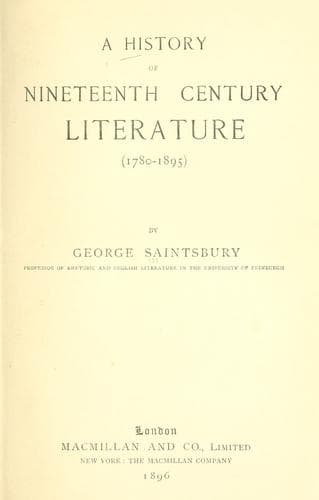
A History of Nineteenth Century Literature (1780-1895)Saintsbury, George
History
A History of Nineteenth Century Literature (1780-1895)
Saintsbury, George
English literature -- 19th century -- History and criticism
Little need be said of Shelley's character. If it had not been for the
disgusting efforts of his maladroit adorers to blacken that not merely
of his hapless young wife, but of every one with whom he came in
contact, it might be treated with the extremest indulgence. Almost a boy
in years at the time of his death, he was, with some late flashes of
sobering, wholly a boy in inability to understand the responsibilities
and the burdens of life. An enthusiast for humanity generally, and
towards individuals a man of infinite generosity and kindliness, he yet
did some of the cruellest and some of not the least disgraceful things
from mere childish want of realising the _pacta conventa_ of the world.
He, wholly ignorant, would, if he could, have turned the wheel of
society the other way, reckless of the horrible confusion and suffering
that he must occasion.
But in pure literary estimation we need take no note of this. In
literature, Shelley, if not of the first three or four, is certainly of
the first ten or twelve. He has, as no poet in England except Blake and
Coleridge in a few flashes had had before him for some century and a
half, the ineffable, the divine intoxication which only the _di majores_
of poetry can communicate to their worshippers. Once again, after all
these generations, it became unnecessary to agree or disagree with the
substance, to take interest or not to take interest in it, to admit or
to contest the presence of faults and blemishes--to do anything except
recognise and submit to the strong pleasure of poetry, the charm of the
highest poetical inspiration.
I think myself, though the opinion is not common among critics, that
this touch is unmistakable even so early as _Queen Mab_. That poem is no
doubt to a certain extent modelled upon Southey, especially upon
_Kehama_, which, as has been observed above, is a far greater poem than
is usually allowed. But the motive was different: the sails might be the
same, but the wind that impelled them was another. By the time of
_Alastor_ it is generally admitted that there could or should have been
little mistake. Nothing, indeed, but the deafening blare of Byron's
brazen trumpet could have silenced this music of the spheres. The
meaning is not very much, though it is passable; but the music is
exquisite. There is just a foundation of Wordsworthian scheme in the
blank verse; but the structure built on it is not Wordsworth's at all,
and there are merely a few borrowed strokes of _technique_, such as the
placing of a long adjective before a monosyllabic noun at the end of
the line, and a strong caesura about two-thirds through that line. All
the rest is Shelley, and wonderful.
Public-domain text, read in full here on John Shaqi.
Reviews
Reviews
No reviews yet
Be the first to share your thoughts on this work.
Elsewhere in the archive
Join the Discussion
Join the discussion
Sign in to leave a comment or review.
Sign InorCreate an account