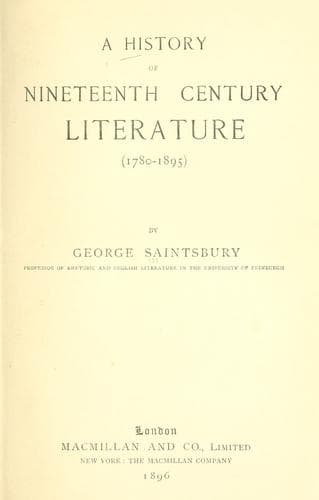
A History of Nineteenth Century Literature (1780-1895)Saintsbury, George
History
A History of Nineteenth Century Literature (1780-1895)
Saintsbury, George
English literature -- 19th century -- History and criticism
It may be questioned whether, fine as _The Revolt of Islam_ is, the
Spenserian stanza was quite so well suited as the "Pindaric" or as blank
verse, or as lyrical measures, to Shelley's genius. It is certainly far
excelled both in the lyrics and in the blank verse of _Prometheus
Unbound_, the first poem which distinctly showed that one of the
greatest lyric poets of the world had been born to England. _The Cenci_
relies more on subject, and, abandoning the lyric appeal, abandons what
Shelley is strongest in; but _Hellas_ restores this. Of his comic
efforts, the chief of which are _Swellfoot the Tyrant_ and _Peter Bell
the Third_, it is perhaps enough to say that his humour, though it
existed, was fitful, and that he was too much of a partisan to keep
sufficiently above his theme. The poems midway between, large and
small--_Prince Athanase_, _The Witch of Atlas_ (an exquisite
and glorious fantasy piece), _Rosalind and Helen_, _Adonais_,
_Epipsychidion_, and the _Triumph of Life_--would alone have made his
fame. But it is in Shelley's smallest poems that his greatest virtue
lies. Not even in the seventeenth century had any writer given so much
that was so purely exquisite. "To Constantia Singing," the "Ozymandias"
sonnet, the "Lines written among the Euganean Hills," the "Stanzas
written in Dejection," the "Ode to the West Wind," the hackneyed
"Cloud," and "Skylark," "Arethusa," the "World's Wanderers," "Music,
when soft voices die," "The flower that smiles to-day," "Rarely, rarely,
comest thou," the "Lament," "One word is too often profaned," the
"Indian Air," the second "Lament," "O world! O life! O time!" (the most
perfect thing of its kind perhaps, in the strict sense of
perfection, that all poetry contains), the "Invitation," and the
"Recollection,"--this long list, which might have been made longer,
contains things absolutely consummate, absolutely unsurpassed, only
rivalled by a few other things as perfect as themselves.
Shelley has been foolishly praised, and it is very likely that the
praise given here may seem to some foolish. It is as hard for praise to
keep the law of the head as for blame to keep the law of the heart. He
has been mischievously and tastelessly excused for errors both in and
out of his writings which need only a kindly silence. In irritation at
the "chatter" over him some have even tried to make out that his
prose--very fine prose indeed, and preserved to us in some welcome
letters and miscellaneous treatises, but capable of being dispensed
with--is more worthy of attention than his verse, which has no parallel
and few peers. But that one thing will remain true in the general
estimate of competent posterity I have no doubt. There are two English
poets, and two only, in whom the purely poetical attraction, exclusive
of and sufficient without all others, is supreme, and these two are
Spenser and Shelley.
Public-domain text, read in full here on John Shaqi.
Reviews
Reviews
No reviews yet
Be the first to share your thoughts on this work.
Elsewhere in the archive
Join the Discussion
Join the discussion
Sign in to leave a comment or review.
Sign InorCreate an account