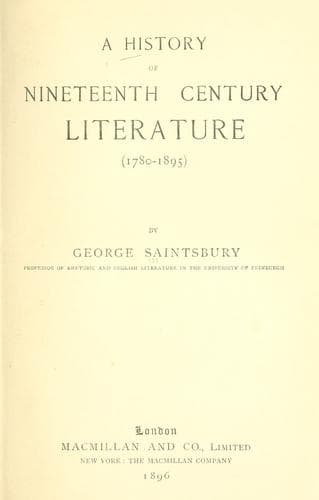
A History of Nineteenth Century Literature (1780-1895)Saintsbury, George
History
A History of Nineteenth Century Literature (1780-1895)
Saintsbury, George
English literature -- 19th century -- History and criticism
The life of John Keats was even shorter and even less marked by striking
events than that of Shelley, and he belonged in point of extraction and
education to a somewhat lower class of society than any of the poets
hitherto mentioned in this chapter. He was the son of a livery stable
keeper who was fairly well off, and he went to no school but a private
one, where, however, he received tolerable instruction and had good
comrades. Born in 1795, he was apprenticed to a surgeon at the age of
fifteen, and even did some work in his profession, till in 1817 his
overmastering passion for literature had its way. He became intimate
with the so-called "Cockney school," or rather with its leaders Leigh
Hunt and Hazlitt--an intimacy, as far as the former was concerned, not
likely to chasten his own taste, but chiefly unfortunate because it led,
in the rancorous state of criticism then existing, to his own efforts
being branded with the same epithet. His first book was published in the
year above mentioned: it did not contain all the verse he had written up
to that time, or the best of it, but it confirmed him in his vocation.
He broke away from surgery, and, having some little means, travelled to
the Isle of Wight, Devonshire, and other parts of England, besides
becoming more and more familiar with men of letters. It was in the Isle
of Wight chiefly that he wrote _Endymion_, which appeared in 1818. This
was savagely and stupidly attacked in _Blackwood_ and the _Quarterly_;
the former article being by some attributed, without a tittle of
evidence, to Lockhart. But the supposed effect of these attacks on
Keats' health was widely exaggerated by some contemporaries, especially
by Byron. The fact was that he had almost from his childhood shown
symptoms of lung disease, which developed itself very rapidly. The sense
of his almost certain fate combined with the ordinary effects of passion
to throw a somewhat hectic air over his correspondence with Miss Fanny
Brawne. His letters to her contain nothing discreditable to him, but
ought never to have been published. He was, however, to bring out his
third and greatest book of verse in 1820; and then he sailed for Italy,
to die on the 23rd of February 1821. He spoke of his name as "writ in
water." Posterity has agreed with him that it is--but in the Water of
Life.
Public-domain text, read in full here on John Shaqi.
Reviews
Reviews
No reviews yet
Be the first to share your thoughts on this work.
Elsewhere in the archive
Join the Discussion
Join the discussion
Sign in to leave a comment or review.
Sign InorCreate an account