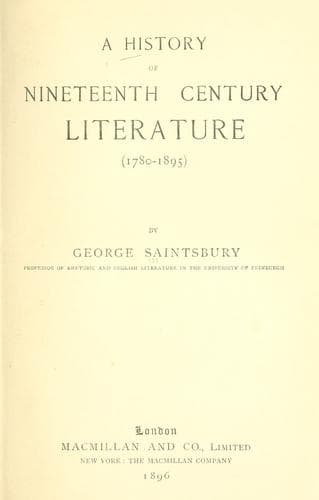
A History of Nineteenth Century Literature (1780-1895)Saintsbury, George
History
A History of Nineteenth Century Literature (1780-1895)
Saintsbury, George
English literature -- 19th century -- History and criticism
With Keats it is very different. He had scarcely reached maturity of any
kind when he died, and he laboured under the very serious disadvantages,
first of an insufficient acquaintance with the great masters, and
secondly of coming early under the influence of a rather small master,
yet a master, Leigh Hunt, who taught him the fluent, gushing, slipshod
style that brought not merely upon him, but upon his mighty successor
Tennyson, the harsh but not in this respect wholly unjust lash of
conservative and academic criticism. But he, as no one of his own
contemporaries did, felt, expressed, and handed on the exact change
wrought in English poetry by the great Romantic movement. Coleridge,
Wordsworth, Scott, and even Southey to some extent, were the authors of
this; but, being the authors, they were necessarily not the results of
it. Byron was fundamentally out of sympathy with it, though by accidents
of time and chance he had to enlist; Shelley, an angel, and an effectual
angel, of poetry, was hardly a man, and still less an Englishman. But
Keats felt it all, expressed what of it he had time and strength to
express, and left the rest to his successors, helped, guided, furthered
by his own example. Keats, in short, is the father, directly or at short
stages of descent, of every English poet born within the present
century who has not been a mere "sport" or exception. He begat Tennyson,
and Tennyson begat all the rest.
The evidences of this are to be seen in almost his earliest poems--not
necessarily in those contained in his earliest volume. Of course they
are not everywhere. There were sure to be, and there were, mere echoes
of eighteenth century verse and mere imitations of earlier writers. But
these may be simply neglected. It is in such pieces as "Calidore" that
the new note is heard; and though something in this note may be due to
Hunt (who had caught the original of it from Wither and Browne), Keats
changed, enriched, and refashioned the thing to such an extent that it
became his own. It is less apparent (though perhaps not less really
present) in his sonnets, despite the magnificence of the famous one on
Chapman's _Homer_, than in the couplet poems, which are written in an
extremely fluent and peculiar verse, very much "enjambed" or overlapped,
and with a frequent indulgence in double rhymes. Hunt had to a certain
extent started this, but he had not succeeded in giving it anything like
the distinct character which it took in Keats' hands.
Public-domain text, read in full here on John Shaqi.
Reviews
Reviews
No reviews yet
Be the first to share your thoughts on this work.
Elsewhere in the archive
Join the Discussion
Join the discussion
Sign in to leave a comment or review.
Sign InorCreate an account