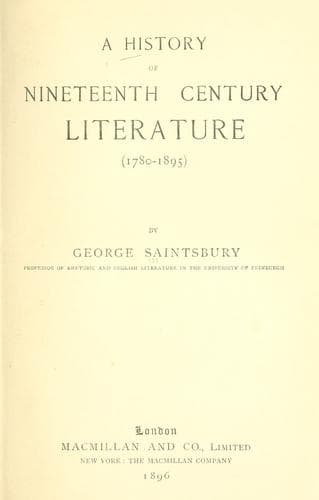
A History of Nineteenth Century Literature (1780-1895)Saintsbury, George
History
A History of Nineteenth Century Literature (1780-1895)
Saintsbury, George
English literature -- 19th century -- History and criticism
_Endymion_ was written in this measure, with rare breaks; and there is
little doubt that the lusciousness of the rhythm, combined as it was
with a certain lusciousness both of subject and (again in unlucky
imitation of Hunt) of handling, had a bad effect on some readers, as
also that the attacks on it were to a certain extent, though not a very
large one, prompted by genuine disgust at the mawkishness, as its author
called it, of the tone. Keats, who was always an admirable critic of his
own work, judged it correctly enough later, except that he was too harsh
to it. But it is a delightful poem to this day, and I do not think that
it is quite just to call it, as it has been called, "not Greek, but
Elizabethan-Romantic." It seems to me quite different from Marlowe or
the author of _Britain's Ida_, and really Greek, but Greek mediaeval,
Greek of the late romance type, refreshed with a wonderful new blood of
English romanticism. And this once more was to be the note of all the
best poetry of the century, the pouring of this new English blood
through the veins of old subjects--classical, mediaeval, foreign, modern.
We were to conquer the whole world of poetical matter with our English
armies, and Keats was the first leader who started the adventure.
The exquisite poetry of his later work showed this general tendency in
all its latest pieces,--clearly in the larger poems, the fine but
perhaps somewhat overpraised _Hyperion_, the admirable _Lamia_, the
exquisite _Eve of St. Agnes_, but still more in the smaller, and most of
all in those twin peaks of all his poetry, the "Ode on a Grecian Urn"
and "La Belle Dame sans Merci." He need indeed have written nothing but
these two to show himself not merely an exquisite poet but a captain and
leader of English poetry for many a year, almost for many a generation
to come. Wordsworth may have given him a little, a very quiet hint for
the first, the more Classical masterpiece; Coleridge something a little
louder for the second, the Romantic. But in neither case did the summons
amount to anything like a cue or a call-bell; it was at best seed that,
if it had not fallen on fresh and fruitful soil, could have come to
nothing.
As it is, and if we wish to see what it came to, we must simply look at
the whole later poetry of the nineteenth century in England. The
operations of the spirit are not to be limited, and it is of course
quite possible that if Keats had not been, something or somebody would
have done his work instead of him. But as it is, it is to Keats that we
must trace Tennyson, Rossetti, Mr. Swinburne, Mr. Morris; to Keats that
even not a little of Browning has to be affiliated; to Keats, directly
or indirectly, that the greater part of the poetry of nearly three
generations owes royalty and allegiance.
Public-domain text, read in full here on John Shaqi.
Reviews
Reviews
No reviews yet
Be the first to share your thoughts on this work.
Elsewhere in the archive
Join the Discussion
Join the discussion
Sign in to leave a comment or review.
Sign InorCreate an account