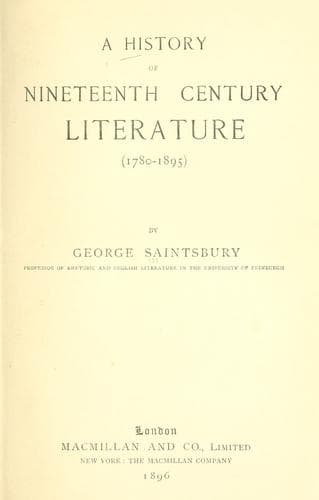
A History of Nineteenth Century Literature (1780-1895)Saintsbury, George
History
A History of Nineteenth Century Literature (1780-1895)
Saintsbury, George
English literature -- 19th century -- History and criticism
During his lifetime, especially during the first half or two-thirds of
his literary career, Moore had a great popularity, and won no small
esteem even among critics; such discredit as attached to him being
chiefly of the moral kind, and that entertained only by very
strait-laced persons. But as the more high-flown and impassioned muses
of Wordsworth, of Shelley, and of Keats gained the public ear in the
third and later decades of the century, a fashion set in of regarding
him as a mere melodious trifler; and this has accentuated itself during
the last twenty years or so, though quite recently some efforts have
been made in protest. This estimate is demonstrably unjust. It is true
that of the strange and high notes of poetry he has very few, of the
very strangest and highest none at all. But his long poems, _Lalla
Rookh_ especially, though somewhat over-burdened with the then
fashionable deck cargo of erudite or would-be erudite notes, possess
merit which none but a very prejudiced critic can, or at least ought to,
overlook. And in other respects he is very nearly, if not quite, at the
top of at least two trees, which, if not quite cedars of Lebanon, are
not mere grass of Parnassus. Moore was a born as well as a trained
musician. But whereas most musicians have since the seventeenth century
been exceedingly ill at verbal numbers, he had a quite extraordinary
knack of composing what are rather disrespectfully called "words." Among
his innumerable songs there are not one or two dozens or scores, but
almost hundreds of quite charmingly melodious things, admirably adjusted
to their music, and delightful by themselves without any kind of
instrument, and as said not sung. And, what is more, among these there
is a very respectable number to which it would be absolutely absurd to
give the name of trifle. "I saw from the beach" is not a trifle, nor
"When in death I shall calm recline," nor "Oft in the stilly night," nor
"Tell me, kind sage, I pray thee," nor many others. They have become so
hackneyed to us in various ways, and some of them happen to be pitched
in a key of diction which, though not better or worse than others, is so
out of fashion, that it seems as if some very respectable judges could
not "focus" Moore at all. To those who can he will seem, not of course
the equal, or anything like the equal, of Burns or Shelley, of Blake or
Keats, but in his own way,--and that a way legitimate and not low,--one
of the first lyrical writers in English. And they will admit a
considerable addition to his claims in his delightful satirical verse,
mainly but not in the least offensively political, in which kind he is
as easily first as in the sentimental song to music.
Public-domain text, read in full here on John Shaqi.
Reviews
Reviews
No reviews yet
Be the first to share your thoughts on this work.
Elsewhere in the archive
Join the Discussion
Join the discussion
Sign in to leave a comment or review.
Sign InorCreate an account