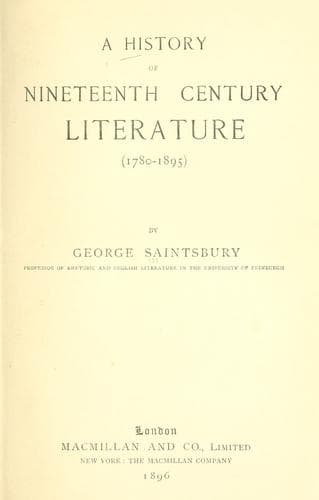
A History of Nineteenth Century Literature (1780-1895)Saintsbury, George
History
A History of Nineteenth Century Literature (1780-1895)
Saintsbury, George
English literature -- 19th century -- History and criticism
Something not dissimilar to the position which Moore occupies on the
more classical wing of the poets of the period is occupied on the other
by Leigh Hunt. Hunt (Henry James Leigh, who called himself and is
generally known by the third only of his Christian names) was born in
London on the 19th October 1784, was educated at Christ's Hospital,
began writing very early, held for a short time a clerkship in a public
office, and then joined his brother in conducting the _Examiner_
newspaper. Fined and imprisoned for a personal libel on the Prince
Regent (1812), Hunt became the fashion with the Opposition; and the
_Story of Rimini_, which he published when he came out of gaol, and
which was written in it, had a good deal of influence. He spent some
years in Italy, to which place he had gone with his family in 1822 to
edit _The Liberal_ and to keep house with Byron--a very disastrous
experiment, the results of which he recorded in an offensive book on his
return. Hunt lived to 18th August 1859, and was rescued from the chronic
state of impecuniosity in which, despite constant literary work, he had
long lived, by a Crown pension and some other assistance in his latest
days. Personally, Leigh Hunt was an agreeable and amiable being enough,
with certain foibles which were rather unfairly magnified in the famous
caricature of him as Harold Skimpole by his friend Dickens, but which
were accompanied by some faults of taste of which Mr. Skimpole is not
accused.
In letters he was a very considerable person; though the best and far
the largest part of his work is in prose, and will be noticed hereafter.
His verse is not great in bulk, and is perhaps more original and
stimulating than positively good. His wide and ardent study of the older
English poets and of those of Italy had enabled him to hit on a novel
style of phrase and rhythm, which has been partly referred to above in
the notice of Keats; his narrative faculty was strong, and some of his
smaller pieces, from his sonnets downwards, are delightful things. "Abou
ben Adhem" unites (a rare thing for its author) amiability with dignity,
stateliness with ease; the "Nile" sonnet is splendid; "Jenny kissed me,"
charming, if not faultless; "The Man and the Fish," far above vulgarity.
The lack of delicate taste which characterised his manners also marred
his verse, which is not unfrequently slipshod, or gushing, or trivially
fluent, and perhaps never relatively so good as the best of his prose.
But he owed little to any but the old masters, and many contemporaries
owed not a little to him.
Public-domain text, read in full here on John Shaqi.
Reviews
Reviews
No reviews yet
Be the first to share your thoughts on this work.
Elsewhere in the archive
Join the Discussion
Join the discussion
Sign in to leave a comment or review.
Sign InorCreate an account