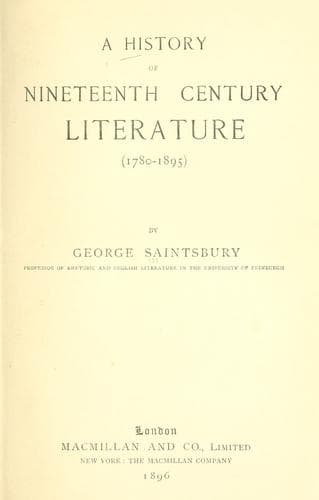
A History of Nineteenth Century Literature (1780-1895)Saintsbury, George
History
A History of Nineteenth Century Literature (1780-1895)
Saintsbury, George
English literature -- 19th century -- History and criticism
A quaint and interesting if not supremely important figure among the
poets of this period, and, if his poetry and prose be taken together, a
very considerable man of letters,--perhaps the most considerable man of
letters in English who was almost totally uneducated,--was James Hogg,
who was born in Ettrick Forest in the year 1772. He was taken from
school to mind sheep so early that much later he had to teach himself
even reading and writing afresh; and, though he must have had the
song-gift early, it was not till he was nearly thirty that he published
anything. He was discovered by Scott, to whom he and his mother supplied
a good deal of matter for the _Border Minstrelsy_, and he published
again in 1803. The rest of his life was divided between writing--with
fair success, though with some ill-luck from bankrupt publishers--and
sheep-farming, on which he constantly lost, though latterly he sat rent
free under the Duke of Buccleuch. He died on 21st November 1835.
Even during his life Hogg underwent a curious process of mythopoeia at
the hands of Wilson and the other wits of _Blackwood's Magazine_, who
made him--partly with his own consent, partly not--into the famous
"Ettrick Shepherd" of the _Noctes Ambrosianae_. "The Shepherd" has Hogg's
exterior features and a good many of his foibles, but is endowed with
considerably more than his genius. Even in his published and
acknowledged works, which are numerous, it is not always quite easy to
be sure of his authorship; for he constantly solicited, frequently
received, and sometimes took without asking, assistance from Lockhart
and others. But enough remains that is different from the work of any of
his known or possible coadjutors to enable us to distinguish his
idiosyncrasy pretty well. In verse he was a very fluent and an
exceedingly unequal writer, who in his long poems chiefly, and not too
happily, followed Scott, but who in the fairy poem of "Kilmeny"
displayed an extraordinary command of a rare form of poetry, and who has
written some dozens of the best songs in the language. The best, but
only a few of the best, of these are "Donald Macdonald," "Donald
M'Gillavry," "The Village of Balmanhapple," and the "Boy's Song." In
prose he chiefly attempted novels, which have no construction at all,
and few merits of dialogue or style, but contain some powerful passages;
while one of them, _The Confessions of a Justified Sinner_, if it is
entirely his, which is very doubtful, is by far the greatest thing he
wrote, being a story of _diablerie_ very well designed, wonderfully
fresh and enthralling in detail, and kept up with hardly a slip to the
end. His other chief prose works are entitled _The Brownie of Bodsbeck_,
_The Three Perils of Man_, _The Three Perils of Woman_, and _Altrive
Tales_, while he also wrote some important, and in parts very offensive,
but also in parts amusing, _Recollections of Sir Walter Scott_. His
verse volumes, no one of which is good throughout, though hardly one is
Public-domain text, read in full here on John Shaqi.
Reviews
Reviews
No reviews yet
Be the first to share your thoughts on this work.
Elsewhere in the archive
Join the Discussion
Join the discussion
Sign in to leave a comment or review.
Sign InorCreate an account