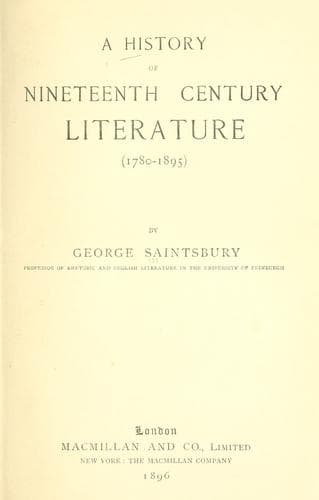
A History of Nineteenth Century Literature (1780-1895)Saintsbury, George
History
A History of Nineteenth Century Literature (1780-1895)
Saintsbury, George
English literature -- 19th century -- History and criticism
reactionary challenge, they bear strong traces of Gray, and still
stronger traces of the picturesque mania which was at the same time
working so strongly in the books of Gilpin and others. But their real
note is the note which, ringing in Coleridge's ear, echoed in all the
poetry of the generation, the note of unison between the aspect of
nature and the thought and emotion of man. In the sonnets "At
Tynemouth," "At Bamborough Castle," and indeed in all, more or less,
there is first the attempt to paint directly what the eye sees, not the
generalised and academic view of the type-scene by a type-poet which had
been the fashion for so long; and secondly, the attempt to connect this
vision with personal experience, passion, or meditation. Bowles does not
do this very well, but he tries to do it; and the others, seeing him
try, went and did it.
His extreme importance as an at least admitted "origin" has procured
him notice somewhat beyond his real deserts; over others we must pass
more rapidly. Robert Bloomfield, born in 1760, was one of those
unfortunate "prodigy" poets whom mistaken kindness encourages. He was
the son of a tailor, went early to agricultural labour, and then became
a shoemaker. His _Farmer's Boy_, an estimable but much overpraised
piece, was published in 1800, and he did other things later. He died
mad, or nearly so, in 1823--a melancholy history repeated pretty closely
a generation later by John Clare. Clare, however, was a better poet than
Bloomfield, and some of the "Poems written in an Asylum" have more than
merely touching merit. James Montgomery,[9] born at Irvine on 4th
November 1771, was the son of a Moravian minister, and intended for his
father's calling. He, however, preferred literature and journalism,
establishing himself chiefly at Sheffield, where he died as late as 1854
(30th April). He had, as editor of the _Sheffield Iris_, some troubles
with the law, and in 1835 was rewarded with a pension. Montgomery was a
rather copious and fairly pleasing minor bard, no bad hand at hymns and
short occasional pieces, and the author of longer things called _The
Wanderer of Switzerland_, _The West Indies_, _The World before the
Flood_, and _The Pelican Island_. Bernard Barton, an amiable Quaker
poet, will probably always be remembered as the friend and correspondent
of Charles Lamb; perhaps also as the father-in-law of Edward FitzGerald.
His verse commended itself both to Southey (who had a kindly but rather
disastrous weakness for minor bards) and to Byron, but has little value.
Barton died in 1849.
Public-domain text, read in full here on John Shaqi.
Reviews
Reviews
No reviews yet
Be the first to share your thoughts on this work.
Elsewhere in the archive
Join the Discussion
Join the discussion
Sign in to leave a comment or review.
Sign InorCreate an account