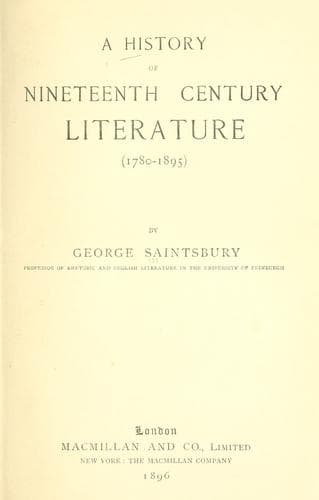
A History of Nineteenth Century Literature (1780-1895)Saintsbury, George
History
A History of Nineteenth Century Literature (1780-1895)
Saintsbury, George
English literature -- 19th century -- History and criticism
The same pair of enemies joined in praising Henry Kirke White, who was
born in 1785 and died when barely twenty-one. Here indeed Southey's
unsurpassed biographical skill enforced the poetaster's merit in a
charming _Memoir_, which assisted White's rather pathetic story. He was
the son of a butcher, a diligent but reluctant lawyer's clerk, an
enthusiastic student, a creditable undergraduate at St. John's,
Cambridge, and a victim of consumption. All this made his verse for a
time popular. But he really deserved the name just affixed to him: he
was a poetaster, and nothing more. The "genius" attributed to him in
Byron's well-known and noble though rather rhetorical lines may be
discovered on an average in about half a dozen poets during any two or
three years of any tolerable poetic period. His best things are
imitations of Cowper in his sacred mood, such as the familiar "Star of
Bethlehem," and even these are generally spoilt by some feebleness or
false note. At his worst he is not far from Della Crusca.[10]
In the same year with Kirke White was born a much better poet, and a
much robuster person in all ways, mental and physical. Allan Cunningham
was a Dumfriesshire man born in the lowest rank, and apprenticed to a
stone-mason, whence in after years he rose to be Chantrey's foreman.
Cunningham began--following a taste very rife at the time--with
imitated, or to speak plainly, forged ballads; but the merit of them
deserved on true grounds the recognition it obtained on false, and he
became a not inconsiderable man of letters of all work. His best known
prose work is the "Lives of the Painters." In verse he is ranked, as a
song writer in Scots, by some next to Burns, and by few lower than Hogg.
Some of his pieces, such as "Fair shines the sun in France," have the
real, the inexplicable, the irresistible song-gift. Cunningham, who was
the friend of many good men and was liked by all of them, died on 29th
October 1842. His elder by eleven years, Robert Tannahill, who was born
in 1774 and died (probably by suicide) in 1810, deserves a few lines in
this tale of Scots singers. Tannahill, like Cunningham in humble
circumstances originally, never became more than a weaver. His verse has
not the _gusto_ of Allan or of Hogg, but is sweet and tender enough.
William Motherwell too, as much younger than Allan as Tannahill was
older (he was born in 1797 and died young in 1835), deserves mention,
and may best receive it here. He was a Conservative journalist, an
antiquary of some mark, and a useful editor of Minstrelsy. Of his
original work, "Jeanie Morrison" is the best known; and those who have
read, especially if they have read it in youth, "The Sword Chant of
Thorstein Raudi," will not dismiss it as Wardour Street; while he did
some other delightful things. Earlier (1812) the heroicomic _Anster
Fair_ of William Tennant (1784-1848) received very high and deserved no
low praise; while William Thom, a weaver like Tannahill, who was a year
Public-domain text, read in full here on John Shaqi.
Reviews
Reviews
No reviews yet
Be the first to share your thoughts on this work.
Elsewhere in the archive
Join the Discussion
Join the discussion
Sign in to leave a comment or review.
Sign InorCreate an account