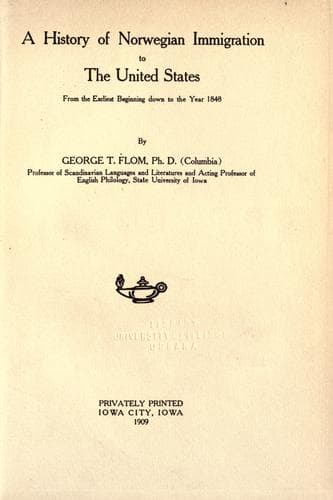
A History of Norwegian Immigration to the United States: From the Earliest Beginning down to the Year 1848Flom, George T. (George Tobias)
History
A History of Norwegian Immigration to the United States: From the Earliest Beginning down to the Year 1848
Flom, George T. (George Tobias)
Norwegians -- United States
The leading spirit in the colony was undoubtedly Hans Barlien. He was
a man of great natural endowment, and he had a fair education. In
Norway he had been a pronounced nationalist of the Wergeland direction
and had taken part in the first peasant uprising. He was for a time a
member of the Storthing (the national parliament). In religion he was a
liberal, which aroused the hostility of the clergy, while his radical
political views called forth the enmity of the official class. He owned
a printing establishment at Overgaarden, and published a paper[162]
in which he did not hesitate to give expression to the principles
for which he stood. This frequently involved him in litigation; and,
feeling himself persecuted, he at last decided to emigrate to America
in 1837.[163] Barlien seems to be the second Norwegian emigrant from
Trondhjem.[164] Lars Tallakson came from Bergen, while the rest of the
colonists were mostly from the region of Stavanger.
[162] _Melkeveien_, the Milky Way.
[163] See J. B. Wist, in _Bygdejaevning_, Madison, Wisconsin, 1903,
p. 158; also _First Chapter of Norwegian Immigration_, pp.
235-236, and _Republikaneren_, February 9, 1900.
[164] The first was Ole Rynning. See above, p. 107, and
_Normaendene i Amerika_ by Knud Langeland, pp. 26-29.
Lee County was but little settled at that time;[165] land was bought
of the Indians for a nominal price, but it often became expensive
enough in the end, since it proved very difficult for many of the
settlers to obtain a clear title from the United States. This is one
reason why the settlement did not grow, though probably not the chief
cause. In 1843 there were between thirty and forty families, writes
John Reierson,[166] but in 1856 there were, according to the census of
that year, only sixty-eight Norwegians in the county. This number had
in 1885 decreased to thirty-one. In the fifties many of the settlers
moved to other localities, but throughout the forties there was a
prosperous colony that contributed not a little to the development of
the community and the county in that early period. The settlement is of
special interest in that it was the first Norwegian settlement in Iowa.
Its founding inaugurated Norwegian colonization in the state which,
particularly in the fifties, resulted in the establishment of a score
of extensive settlements in the central and the northern counties.
[165] The first postoffice was established in Lee County in 1841.
[166] _Veiviser for Emigranter_, 1843.
Public-domain text, read in full here on John Shaqi.
Reviews
Reviews
No reviews yet
Be the first to share your thoughts on this work.
Elsewhere in the archive
Join the Discussion
Join the discussion
Sign in to leave a comment or review.
Sign InorCreate an account