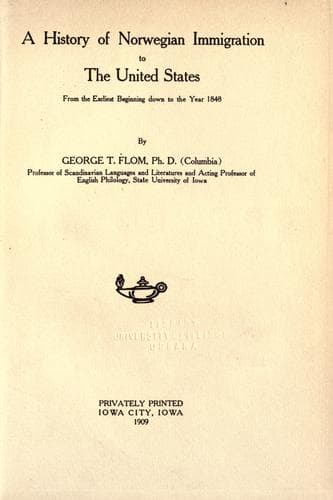
A History of Norwegian Immigration to the United States: From the Earliest Beginning down to the Year 1848Flom, George T. (George Tobias)
History
A History of Norwegian Immigration to the United States: From the Earliest Beginning down to the Year 1848
Flom, George T. (George Tobias)
Norwegians -- United States
There are many reasons why the Sugar Creek Settlement did not grow
as did the later settlements north and west. First of all, land was
not of the best in Lee County. And then, the locality was rather too
far south, Norwegians have everywhere in America thriven best in the
more northerly localities. Again, the tide of emigration from the
vicinity of Stavanger was not sufficiently heavy to recruit the various
settlements already established by immigrants from that region. The
majority of those who came went direct to the Fox River Settlement in
Northern Illinois, which offered unsurpassed natural advantages. To
be sure, the Shelby County (Missouri) and the Lee County settlements
might have been recruited from other districts in Norway. But it must
be remembered that such other districts as had begun to take part in
the emigration movement had their attention directed just at this
time in another direction. The other provinces in question are Voss,
Telemarken, and Numedal. It was representatives of these that founded
the Wisconsin settlements in 1839-40, and in them the great majority
of immigrants from those provinces located in the following decade.
This is also true of those who came from Hardanger, Sogn,[167] and from
Western Norway in general.
[167] Immigration from Sogn was at first directed almost
exclusively to Boone County, Illinois, and Dane County,
Wisconsin.
There is still another reason why the colony did not grow. Beyond the
common desire of material betterment, there was too little of community
of interest. It is enough to mention that several different religious
sects were represented in the little settlement, chief among which were
the Quakers and the Latter Day Saints. Just across the Mississippi
was the town of Nauvoo,[168] which was a Mormon center at the time.
When the Mormons who did not believe in polygamy established themselves
at Lamoni some years later, many Norwegians of that belief went
with them.[169] And not a few of the Quakers joined American Quaker
settlements farther north, as in Salem, Henry County.[170] In the later
fifties a prosperous colony was founded at and south of Legrand in
Marshall County. A few of the early pioneers, however, remained and
their descendants live in Lee County to-day. Finally, the difficulty of
securing a title to the land upon which many Norwegians had settled,
to which reference has been made above, undoubtedly drove many to seek
homes elsewhere.[171]
[168] In the Fox River Settlement in Illinois many Norwegians
joined the Mormons and later moved to Utah. Bishop Canute
Peterson was one of these.
[169] The Mormons first moved into Iowa in 1839, having received
assurance of protection and the liberty to practice their
belief from Governor Lucas in that year. They located in
Lee County not far from Sugar Creek. The town of Nauvoo,
Illinois, had been bought by them. The name was changed from
Commerce.
Public-domain text, read in full here on John Shaqi.
Reviews
Reviews
No reviews yet
Be the first to share your thoughts on this work.
Elsewhere in the archive
Join the Discussion
Join the discussion
Sign in to leave a comment or review.
Sign InorCreate an account