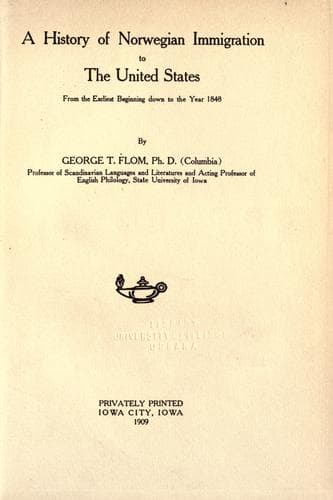
A History of Norwegian Immigration to the United States: From the Earliest Beginning down to the Year 1848Flom, George T. (George Tobias)
History
A History of Norwegian Immigration to the United States: From the Earliest Beginning down to the Year 1848
Flom, George T. (George Tobias)
Norwegians -- United States
[177] Reverend J. W. C. Dietrichson, speaking of the Wiota
Settlement in 1844 says, that there had been organized a
congregation that year, which numbered about one hundred
members, of whom the larger part were from Voss; these,
he says, had settled there for the most part in 1843. He
mentions Per Davidson as deacon and a leading member of the
church, and Knud Knudson as one who by great energy had
acquired considerable wealth.
CHAPTER XXIII
_Growth of the Jefferson Prairie Settlement from
1841 to 1845. The First Norwegian Land
Owners in Rock County._
In an earlier chapter I have given an account of the coming of
Norwegians to Jefferson Prairie in 1838-39. We found that a
considerable number of persons had located there by 1840, principally
immigrants from Numedal. These first settlers located in the southern
half of Clinton Township, but others soon came who settled still
farther south, so that the settlement soon came to include a portion
of the Township of Manchester in Boone County, Illinois. The first
settlers here were Tönnes Tolleivson (or Tollefson) from Jæderen, and
Svend Larson, both of whom settled in Boone County in 1840; Tollefson
had come to America in the fall of 1839, presumably spending the winter
of 1839-40 on Jefferson Prairie.
The settlement thus came to be divided into a northern and a southern
part, the immigrant settlers in the two representing different
provinces in Norway. The Numedalians settled as we have seen, nearer
Clinton and in general in the northern end of Jefferson Prairie; in
fact they occupied most of the prairie proper. The southern portion,
the timber land, come to be settled principally by immigrants from
Voss. Very few of these located in the Town of Clinton; they
selected homes in the early days, for the most part, just where their
descendants now live, on the south side of the state line, in Illinois.
The whole settlement extends from about a mile and a half south of
Clinton across the prairie and into the timber which began about three
miles south of Clinton and extends about four miles down into Illinois.
We have observed above that Ole Nattestad's house became the stopping
place of the earliest immigrants to Jefferson Prairie. In a similar
way D. B. Egery's place,[178] located four miles southwest of the
Nattestad cabin on the trail to Beloit, became the headquarters for
many a Norwegian immigrant in that early day. Speaking of him, H. L.
Skavlem gives testimony to his kindness and the readiness with which he
lent a helping hand to the incoming settlers in his vicinity, who were
seeking a place to establish a home in the wilderness. As soon as the
immigrants arrived, parties of two or three would fill their knapsacks
(skræppe) with provisions and strike out in various directions to "spy
out the land."[179]
Public-domain text, read in full here on John Shaqi.
Reviews
Reviews
No reviews yet
Be the first to share your thoughts on this work.
Elsewhere in the archive
Join the Discussion
Join the discussion
Sign in to leave a comment or review.
Sign InorCreate an account