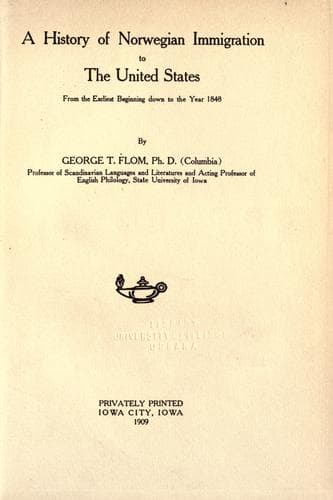
A History of Norwegian Immigration to the United States: From the Earliest Beginning down to the Year 1848Flom, George T. (George Tobias)
History
A History of Norwegian Immigration to the United States: From the Earliest Beginning down to the Year 1848
Flom, George T. (George Tobias)
Norwegians -- United States
On the third of August a small group of immigrants arrived and selected
a home and settled directly west of West Koshkonong Church, on section
fourteen. These were Knut A. Juve,[243] his brother, Knut Gjötil
(or Jöitil), and his sister, Tone Lien, then a widow. Juve owned an
estate in Telemarken, which he sold upon deciding to emigrate, in May,
1843. They sailed on the brig _Washington_, which carried eighty-six
passengers, mostly from the parishes of Hvideseid and Laurdal.[244]
They landed in New York on July fourth. It was the intention of the
members of this party to settle in Illinois, but in Milwaukee they were
advised against doing so; they were told that many who had settled in
Illinois had later moved to Wisconsin and bought homes there. Many
remained in Milwaukee, some went direct to Koshkonong, while others,
including the Juve party, went to Wind Lake, in Racine County. Knut
Juve was not pleased with Wind Lake. One day he met a pioneer settler
from the Town of Christiana, Dane County, who, when he noticed Juve's
downcast condition, said to him: "Go farther west; not until you get
to Koshkonong are you in America." Juve acted upon the advice; he and
his brother and sister started west soon after, arriving in the Town
of Pleasant Spring, as we have said, on the third day of August. Half
a mile west of where the church was built two years later, they built
their hut of brushwood, thatched with straw.
[243] Knut Juve was born in 1799. Knut Jöitil in 1803.
[244] Most of them in fair circumstances says Juve.
"Our furniture," says Juve,[245] "consisted of a few chests, that
were used both as table and chairs, while the bed was arranged on the
ground on some twigs and grass." Here they lived till October, when
they made a dugout, in which they lived till the following summer. Both
Juve and Jöitil were soon, however, taken ill with the climate fever.
In the interview from which we have already cited, he speaks of how
many a time during his illness he longed back to the old home, kindred
and friends in his native land. In the summer of 1844 a log cabin
was built, and not long after Jöitil and the widowed sister also had
erected log cabins of their own in his immediate neighborhood. In the
spring of 1844 Juve broke two acres of ground and raised a little corn
and potatoes; the next summer he raised enough of grain and potatoes
for family use; the third year he was able to sell a little. Such were
the beginnings of agriculture in the wilderness.
[245] Interview in _Billed-Magazin_, 1870, page twenty-four.
Public-domain text, read in full here on John Shaqi.
Reviews
Reviews
No reviews yet
Be the first to share your thoughts on this work.
Elsewhere in the archive
Join the Discussion
Join the discussion
Sign in to leave a comment or review.
Sign InorCreate an account