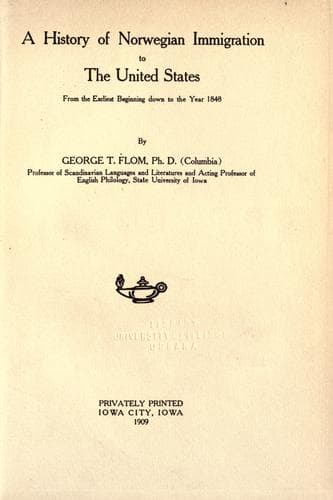
A History of Norwegian Immigration to the United States: From the Earliest Beginning down to the Year 1848Flom, George T. (George Tobias)
History
A History of Norwegian Immigration to the United States: From the Earliest Beginning down to the Year 1848
Flom, George T. (George Tobias)
Norwegians -- United States
About the middle of August a large number came and located in the
settlement. Among these were Gunleik T. Sundbö (b.1785), with wife
and three sons, two of whom were married and had families.[246]
Others who came were: Tostein G. Bringa (b. 1817), with wife and son,
Halvor Laurantson Fosseim (b. 1810), and family, his brother, Ole L.
Fosseim, and Ole K. Dyrland (b. 1819).[247] Sundbö, Bringa, Fosseim
and Dyrland all bought land not far from Knut Juve and Knut Jöitil.
During the next two months the following arrived: Torbjörn G. Vik,
with wife and son Guttorm, and daughter Anna from Siljord, Aslak E.
Groven (b. 1812), and family, from Laurdal, Ole E. Næset (b. 1796),
and family, and his brother Aadne, from Vinje, and Gunnar T. Mandt,
from Moe, Telemarken.[248] Groven settled about a mile east of the
West Koshkonong Church near the Christiana Township line; the two
Næset brothers also located near there. This group of immigrants came
via Racine County, where they had remained a few weeks resting after
the journey, as the guests of Even Heg. They arrived on Koshkonong
Prairie in the latter part of September, having walked from Muskego.
Gunnar Mandt first came to Pleasant Spring, but as he did not have
anything[249] with which to buy land, as he says, he worked for
others there and elsewhere for five years. From his autobiographical
sketch[250] I cite the following account of the method of threshing in
those days:
"There were no mowers, no reapers, binders or threshing machines,
everything had to be done by hand. When we were to thrash, the
sheaves of wheat or oats were placed on the ground in a large
circle. Then three or four yoke of oxen were tied together with
an iron chain; one man stood in the center of the circle on the
sheaves of grain and drove the oxen around over the grain. These
would then stamp the kernels out of the straw little by little, and
so we kept on, until we had the sheaves replaced by new ones and
got the straw away. For cleansing the grain thus secured, we used
short basins or bowls such as were made in Norway formerly. After
a while we got a kind of fanning-mill, mower, reaper, etc. But
they were imperfect and cannot be compared with the machines and
implements used nowadays."
[246] Torkild Sundbö and wife, Margit, later moved to Sun Prairie.
[247] Dyrland says there were 211 immigrants on the ship on which
he came, and most of these, it seems, were from Telemarken.
[248] His brother, also named Gunnar, came to America in 1848; T.
G. Mandt, inventor of the Stoughton wagon, was a son of the
latter.
[249] Endre Vraa paid his passage to America.
[250] Published in _Amerika_ and _Skandinaven_ in January, 1906.
Public-domain text, read in full here on John Shaqi.
Reviews
Reviews
No reviews yet
Be the first to share your thoughts on this work.
Elsewhere in the archive
Join the Discussion
Join the discussion
Sign in to leave a comment or review.
Sign InorCreate an account