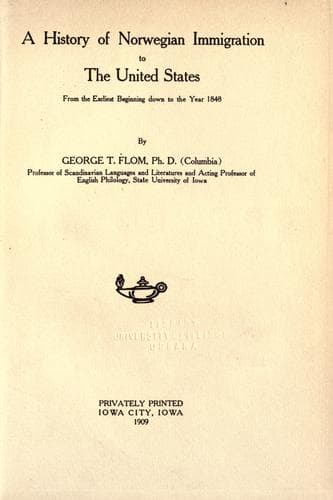
A History of Norwegian Immigration to the United States: From the Earliest Beginning down to the Year 1848Flom, George T. (George Tobias)
History
A History of Norwegian Immigration to the United States: From the Earliest Beginning down to the Year 1848
Flom, George T. (George Tobias)
Norwegians -- United States
Those who came in the latter part of June, 1850, and settled on
Washington Prairie were: Eric Anderson (Rudi),[427] the brothers Ole
and Staale T. Haugen from Flekkefjord, Ole G. Jevne, Ole and Andrew
A. Lomen, Knut A. Bakken, Anders Hauge, John J. Quale, and Halvor H.
Groven, all from Valders, and Mikkel Omli from Telemarken. On July
third another party headed by Nels Johnson[428] arrived, including
Tollef Simonson Aae, Knud Opdahl, Jacob Abrahamson,[429] Iver P. Quale,
Gjermund Johnson (Kaasa),[430] and John Thun.
[427] See above page 232.
[428] The father of Martin N. Johnson, member of Congress from
North Dakota. Nelson Johnson was one of the founders of the
Muskego Settlement in Wisconsin in 1839. He later entered
the Methodist ministry and was for two years, 1855-1857,
pastor of the Norwegian M. E. Church in Cambridge, Wisconsin.
With the exception of these two years he lived in Winneshiek
County until his death in 1882.
[429] Father of Rev. Abraham Jacobson, to whom I am in part
indebted for facts on the early settlement of Washington
Prairie. Rev. Jacobson has also printed a pamphlet: _The
Pioneer Norwegians_, Decorah, 1905, 16 pages, which is a most
valuable contribution to the pioneer history of Winneshiek
County. A very brief chapter on the "Pioneer Norwegians" may
also be found in Alexander's _History of Winneshiek County_,
1882, pages 185-186.
[430] A brother of Nels Johnson. Thun was from Valders.
Of the coming of this party Reverend Jacobson has given the following
account: In the spring of 1850 his parents and a number of other
families left Muskego to move out west. The leader of the party
was Nels Johnson; he had a large military wagon drawn by six oxen.
"This had a big box on, filled with household goods and covered with
white canvas. On the outside was placed, lengthwise, the wagon box,
several joints of stove pipe, so the outfit, with a little stretch
of imagination," says Rev. Jacobson, "looked like a man-of-war; this
was the so-called 'prairie-schooner.' Then there were other vehicles
of all sizes and shapes, from truck wagons, the wheels of which were
made of solid sections of oak logs, down to the two-wheel carts." At
Koshkonong, Dane County, so many more joined them that they were in
all over one hundred individuals; the caravan included furthermore
now two hundred head of cattle, a few hogs and sheep, a mare and a
colt. They drove on via Madison, then a little village, to Prairie du
Chien, where the party divided one-half going to Vernon County,[431]
Wisconsin, the other half to Iowa. Reverend Jacobson says of the
journey at this point:
Public-domain text, read in full here on John Shaqi.
Reviews
Reviews
No reviews yet
Be the first to share your thoughts on this work.
Elsewhere in the archive
Join the Discussion
Join the discussion
Sign in to leave a comment or review.
Sign InorCreate an account