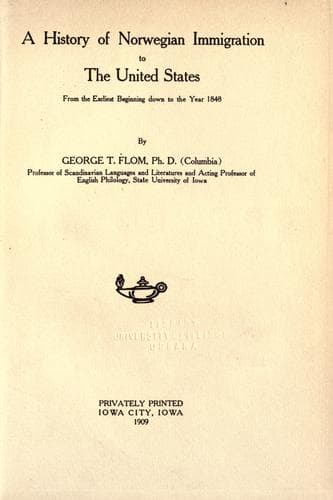
A History of Norwegian Immigration to the United States: From the Earliest Beginning down to the Year 1848Flom, George T. (George Tobias)
History
A History of Norwegian Immigration to the United States: From the Earliest Beginning down to the Year 1848
Flom, George T. (George Tobias)
Norwegians -- United States
The Wisconsin river had to be crossed on a small ferry boat, the
propelling power was furnished by a horse placed on a tread-power
which worked the paddle-wheels. Only one wagon and a team at a
time could be taken aboard. The herd of loose cattle had to swim
over the river, all of which was accomplished without any accident
worthy of note. The ferry boat at Prairie du Chien was larger
and propelled by four mule power, but the water being high, the
Mississippi River was nearly two miles wide, and much time was
taken to get all to the western bank. Thirteen miles northwest from
McGregor at Poverty Point, since called Monona, another halt of a
creek was made. The scouting party before alluded to had visited
several localities, and opinions were divided as to which was the
best point to settle down. The company was now divided into three
divisions, we going with the original leader to the vicinity of
Decorah, landing on our claims on the third of July. The journey
had taken five weeks, counting from the time of starting. Those who
had room enough slept under the wagon covers, the others slept on
the bare ground under the wagons.[432]
[431] The Norwegian settlement at and about Westby, Vernon Co.,
dates from this time, 1850.
[432] Speaking of the Indians Rev. Jacobson says, "They had their
homes in the Territory of Minnesota, and did not molest the
settlers in the least." On the banks of the Upper Iowa river
many Indian graves were found. The bodies were buried in a
sitting position, with the head sometimes above the ground. A
forked stick put up like a post at each end of the grave held
a ridge pole on which leaned thin boards, placed slanting
to each side of the grave. Thus each grave presented the
appearance of the gable of a small house.
Of this party Simonson, Opdahl, Abrahamson, and Quale settled in
Springfield, the rest in Decorah and Glenwood Townships.[433] Most of
the members of these parties had come to America several years before,
as Opdahl in 1848 and Tostenson in 1847; three of them, as we know,
Rudi and the two Johnsons, had immigrated in 1839.
[433] The eastern two-thirds of Winneshiek County clear to the
Minnesota line in a few years became extensively settled by
Norwegians.
A small party from Jefferson Prairie, Wisconsin, including Tore P.
Skotland and his brother Endre P. Sandanger, Ellef and Lars Land,
natives of Ringerike, also came the same summer; these secured claims
around Calmar. The first list of landed assessments in Winneshiek
County[434] records the names of Jacob Abrahamson, Knud Guldbrandson
(Opdahl), Ole Gullikson (Jevne), Egbert Guldbrandson (Saland), Erik
Clement (Skaali), Halvor Halvorson (Groven), O. A. Lomen, Ole Larsen
Bergan, Mikkel Omli, Tollef Simonson (Aae), T. Hulverson, and Ole
Tostenson.
Public-domain text, read in full here on John Shaqi.
Reviews
Reviews
No reviews yet
Be the first to share your thoughts on this work.
Elsewhere in the archive
Join the Discussion
Join the discussion
Sign in to leave a comment or review.
Sign InorCreate an account