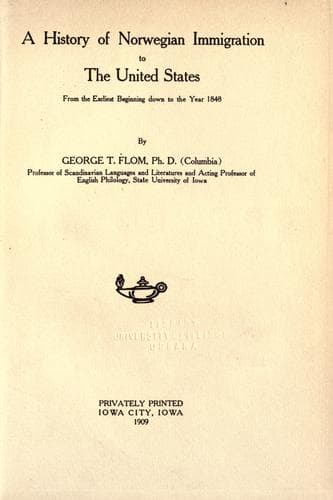
A History of Norwegian Immigration to the United States: From the Earliest Beginning down to the Year 1848Flom, George T. (George Tobias)
History
A History of Norwegian Immigration to the United States: From the Earliest Beginning down to the Year 1848
Flom, George T. (George Tobias)
Norwegians -- United States
Variant forms of the name Wassingatun are, as given in the prospectus,
Wessington, Whessingtone, Wasengtone, Wassington and finally
Washington. The prospectus itself cites from Machold's _History of the
Scandinavians in Pennsylvania_.
In January, 1783, General George Washington was elected honorary member
of the Society on account of his Norse ancestry. On the twenty-sixth
of August, that year, a banquet was given at the City Tavern under
the auspices of the Society, in celebration of the recognition by
Sweden, Norway, and Denmark of the independence of the United States of
America. John Stille was for many years secretary of the Society; after
his death in 1802 all traces of it seem to have vanished. Just when the
Societies Scandinaviensis ceased to exist, the Historian cannot say. On
February twentieth, 1868, eighteen gentlemen, all of Scandinavian birth
and residents of Philadelphia, met together for the purpose of forming
a society, and _The Scandinavian Society of Philadelphia_ was founded,
an organization which regards itself a continuation of the original
society. The chief object of the Society is benevolence.
The name of at least one Norwegian who fell in the early wars against
the Indians has come down to us. Frank Peterson, who had enlisted on
the fifteenth of June, 1808, was among those who fell at Fort Dearborn
in 1812, among the "first martyrs of the West," in an attack by five
hundred Pottawattamie Indians. In this battle two-thirds of the whites
were killed and the rest taken prisoners.
At a later date some other names also appear, but those given are the
only ones of which we have any record. I shall mention here that of Ole
Haugen, who probably was the first Norwegian to settle in the State of
Massachusetts. Haugen was from Bergen, Norway, and located in Middlesex
County, that state, in 1815. Alexander Paaske, himself an early
immigrant from Bergen, living in Lowell, Mass., and who was present
at Haugen's deathbed, is the source of the above fact. Though going
beyond the scope of our brief survey of this earliest immigration, it
may be of interest here to know that as early as 1817, a girl from
Voss, Norway, Anna Vetlahuso, emigrated to America with her husband, a
German sailor in Bergen, and settled somewhere in South America. The
next recorded names in the order of emigration to the United States
are Kleng Peerson and Knud Olson Eide, who in 1821 became the advance
guard of a group of fifty-two emigrants that in 1825 founded the first
Norwegian settlement in this country. It is of this sailing and the
leaders of this group that I now wish to speak; of Peerson I shall give
a brief account below.
CHAPTER IV
_The Sloopers of 1825. The First Norwegian Settlement
in America. Kleng Peerson._
Public-domain text, read in full here on John Shaqi.
Reviews
Reviews
No reviews yet
Be the first to share your thoughts on this work.
Join the Discussion
Join the discussion
Sign in to leave a comment or review.
Sign InorCreate an account