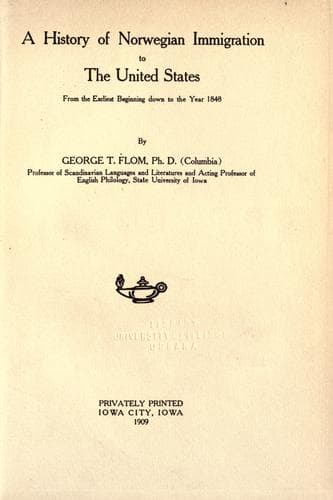
A History of Norwegian Immigration to the United States: From the Earliest Beginning down to the Year 1848Flom, George T. (George Tobias)
History
A History of Norwegian Immigration to the United States: From the Earliest Beginning down to the Year 1848
Flom, George T. (George Tobias)
Norwegians -- United States
First then we may consider the causes which arise from economic
conditions. These are well illustrated by the Scandinavian countries,
slightly modified in each case by the operation of the special causes.
Norway is a land of mountains, these making up in the fact fifty-nine
per cent of its total area, while forty-four per cent of the soil of
Sweden is unproductive. The winters are long and severe, the cold
weather frequently sets in too early for the crops to ripen; with crop
failure comes lack of work for the laboring classes, and, burdened
by heavy taxation, as was the Norwegian farmer only too often in the
middle of the last century, debt and impoverishment for the holders
of the numerous encumbered smaller estates. In Norway, especially,
the rewards of labor are meagre and the opportunities for material
betterment small.[37] "Hard times" and the inability of the country
to support the rapidly increasing population has, then, been a most
potent factor.[38] The same will hold true of Sweden, though in a
somewhat less degree. Denmark is better able to support a population
of one hundred and forty-eight to the square mile than Sweden one of
twenty-eight or Norway one of eighteen.[39]
[37] A great change for the better has been taking place during the
last few years.
[38] Thus the failure of crops and the famine in Northern Sweden,
Finland, and Norway in 1902 was followed by a vastly increased
immigration from these sections. See above page 28. Compare
Table II, Appendix.
[39] The area and population of the three countries are:--Sweden,
area 172,876 sq. m., population in 1901, 5,175,228; Norway,
area 124,129, population in 1900, 2,239,880; Denmark, area
15,360, population in 1901, 2,447,441.
In this connection compare above the statistics of immigration from
the three countries, which are much lower for Denmark than for Norway
and Sweden. The Danes at home are a contented people, and it is
noticeable also that it is they who are most conservative here, who
foster the closest relation with the old home, and who consequently
become Americanized last. The Norwegians are the most discontented, are
readiest for a change, are quickest to try the new; and it is they who
most readily break the bonds that bind them to their native country,
who most quickly adapt themselves to the conditions here, and who most
rapidly become Americanized.
Public-domain text, read in full here on John Shaqi.
Reviews
Reviews
No reviews yet
Be the first to share your thoughts on this work.
Join the Discussion
Join the discussion
Sign in to leave a comment or review.
Sign InorCreate an account