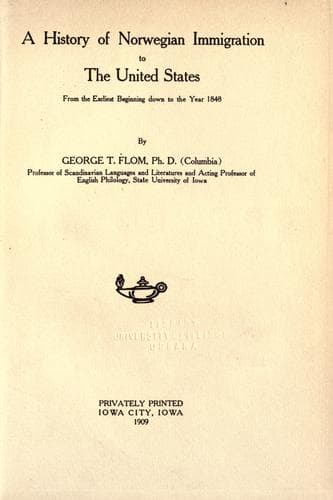
A History of Norwegian Immigration to the United States: From the Earliest Beginning down to the Year 1848Flom, George T. (George Tobias)
History
A History of Norwegian Immigration to the United States: From the Earliest Beginning down to the Year 1848
Flom, George T. (George Tobias)
Norwegians -- United States
The immigrants who came in the _Aegir_ seem to have intended to settle
in La Salle County, but in Chicago were advised by two Americans not to
go there. They were also partly influenced by Norwegian immigrants[72]
who were dissatisfied with that locality, and who recommended Iroquois
County as a more desirable location to settle. They were told that the
Fox River Valley was a very unhealthy place, the settlers were dying of
ague and fever, and it was a misfortune that they had ever been induced
to locate there. (Knut Langeland also records the fact that the fever
raged in the whole of the Fox River Valley from Muskego, in Wisconsin,
to the Mississippi River in Illinois, that summer, but that the
condition in La Salle was no worse than elsewhere). So the intending
settlers deputed three men to explore the country for a site for a new
colony.
[72] Björn Anderson seems to have in part been instrumental in
their not going to La Salle County, but there is no evidence
that he recommended Iroquois County as far as I am aware.
These, Ole Rynning, Ingebrigt Brudvig and Ole Nattestad,[73] walked
south along the line of the present Illinois Central Railroad,
selecting the location at Beaver Creek in Iroquois County. Of the
further history of this unfortunate and short lived colony, the
reader may find an account in Dietrichson's brief discussion of the
settlement, or in Langeland's or R. B. Anderson's book. The majority of
the settlers died during the spring in the low and unhealthy climate.
Ole Rynning himself died and lies buried there. The few survivors
left for La Salle County the following spring. Mons Aadland refused,
however, to go. He remained in Beaver Creek three years longer; selling
his land in 1840 for a herd of cattle and, moving north, he located in
Racine County, being therefore one of the earliest pioneers in this
part of Wisconsin.
[73] Niels Veste may also have been of the party.
Ole Rynning's name is most closely associated with the brief history of
the Beaver Creek Settlement. We have already seen above how his book,
_Sandfaerdig Beretning om Amerika_, came to have a very far-reaching
influence upon Norwegian emigration. This book Rynning wrote that
winter in the Beaver Creek Settlement. It was printed in Norway the
next year. It soon became widely distributed and continued for over a
decade to exert a powerful influence upon Norwegian emigration from
Voss, east to Hedemarken, and north to Gudbrandsdalen, in these latter
provinces, at the close of the decade, especially.
Public-domain text, read in full here on John Shaqi.
Reviews
Reviews
No reviews yet
Be the first to share your thoughts on this work.
Elsewhere in the archive
Join the Discussion
Join the discussion
Sign in to leave a comment or review.
Sign InorCreate an account