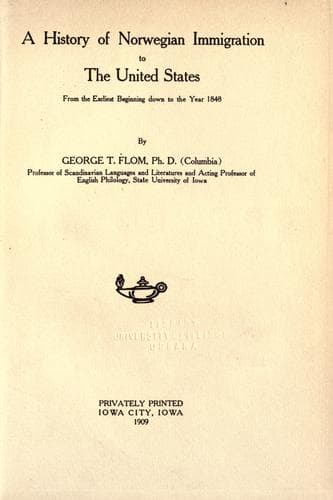
A History of Norwegian Immigration to the United States: From the Earliest Beginning down to the Year 1848Flom, George T. (George Tobias)
History
A History of Norwegian Immigration to the United States: From the Earliest Beginning down to the Year 1848
Flom, George T. (George Tobias)
Norwegians -- United States
We have, on page 86 above, observed that Rynning formulated certain
questions which he set about answering for the information of intending
immigrants. It will be of interest to note here the nature of some
of his answers. The first question as to the nature of the country,
he answers by giving a very intelligent account of the topography and
climate of the country, the soil in the different parts, and of what
the produce of the different sections consists. In answer to the third
question, he says that the United States is more than twenty times as
large as Norway, that the greater part of the country is not yet even
under cultivation, and that there is room for a population more than
a hundred times as great as that of Norway. There need be no fear, he
says, that the country will be full in fifty years.
The fourth question as to where the Norwegian immigrants have located
especially, he answers by saying, that in New York, Rochester, Detroit,
Chicago, Philadelphia and New Orleans, there are said to be individual
settlers; but he mentions four places where several have settled,
namely: (1) Orleans County, New York, but where, he says, there are now
only two or three families left; (2) La Salle County, Illinois, where,
he says, there are about twenty families; (3) White County, Indiana, on
the Tippecanoe River. "Here," he says, live "only two Norwegians from
Drammen, who, together, own about eleven hundred acres of land"; (4)
Shelby County, Missouri, where a few Norwegians from Stavanger settled
in the spring of 1837; (5) Iroquois County, Illinois. "Here," he says,
"there are eleven or twelve families of those who came last summer."
The sixth question as to the land in these localities, he answers by
praising the beauty and the fertility of the prairie. And as to the
price of land, he says, that it has hitherto been $1.25 per acre, but
that he has heard that hereafter land is to be divided into three
classes and the price of land of the third class is to be half a dollar
an acre. He then offers explicit directions as to how to go about
securing land. He thereupon gives the prices of livestock at the time,
and of produce, etc. A horse, we learn, costs from fifty to a hundred
dollars, a yoke of oxen, sixty to eighty. A milk cow with calf, sixteen
to twenty, a sheep, two to three, hogs are six to ten dollars a head,
pork costs three to five shillings a "mark," butter six to twelve, a
barrel of (wheat) flour, eight to ten dollars; a barrel of cornmeal,
two and a half to three dollars; a barrel of potatoes, one dollar; a
pound of coffee, twenty shillings; a barrel of salt is five dollars
(Norwegian). But in Wisconsin Territory, the prices are two to three
times higher, while farther south, everything is cheaper.
Public-domain text, read in full here on John Shaqi.
Reviews
Reviews
No reviews yet
Be the first to share your thoughts on this work.
Elsewhere in the archive
Join the Discussion
Join the discussion
Sign in to leave a comment or review.
Sign InorCreate an account